Many retail store chains begin their digitalization journey by purchasing hardware or software, only to hit roadblocks within months. This momentum stall is often caused by unintegrated operational data, store staff struggling to adapt to new workflows, and managers unable to prove tangible financial or operational impact to top leadership.
The root cause of retail digital transformation failures rarely lies in the technology – it lies in the order of execution. Buying technology without mapping operational baselines only accelerates chaos and wastes budget. To sustainably transform a multi-outlet chain, you need a structured approach that builds credibility, aligns internal stakeholders, and delivers measurable value from day one.
This article presents a practical, phased 6-month retail store digitalization roadmap to guide your team from the initial process audit to a wide-scale rollout across 5 to 100+ outlets.
Why Retail Store Digitalization Often Fails Mid-Way
Building a sustainable retail technology initiative requires a deep understanding of why previous projects failed. Before allocating budget to a new system, you must anticipate these four primary traps:
- Automating Broken Processes: Implementing technology on top of unstandardized workflows only accelerates operational misalignment. If price update or goods receiving workflows at the store level are still disorganized, software will not solve the underlying issue.
- Attempting Full Transformation at Once: Replacing Point of Sale (POS) systems, inventory management, planograms, and loyalty programs simultaneously drains operational capacity and overwhelms IT bandwidth.
- Bypassing Master Data Readiness: Duplicated SKU data, inconsistent price synchronization, and incomplete product attributes corrupt system integration and trigger errors during checkout.
- Lacking Early Proof of Results (Quick Wins): Without measurable quick wins within the first 90 days, executive sponsorship risks fading, and budget allocations may be redirected to other initiatives.
A successful digital transformation strategy consistently focuses on maintaining internal momentum through phased execution, rather than high-risk, sweeping overhauls.
The Six Phases of Retail Store Digitalization
Before diving into the monthly breakdown, here is a high-level overview of the 6-month phased retail technology implementation roadmap:
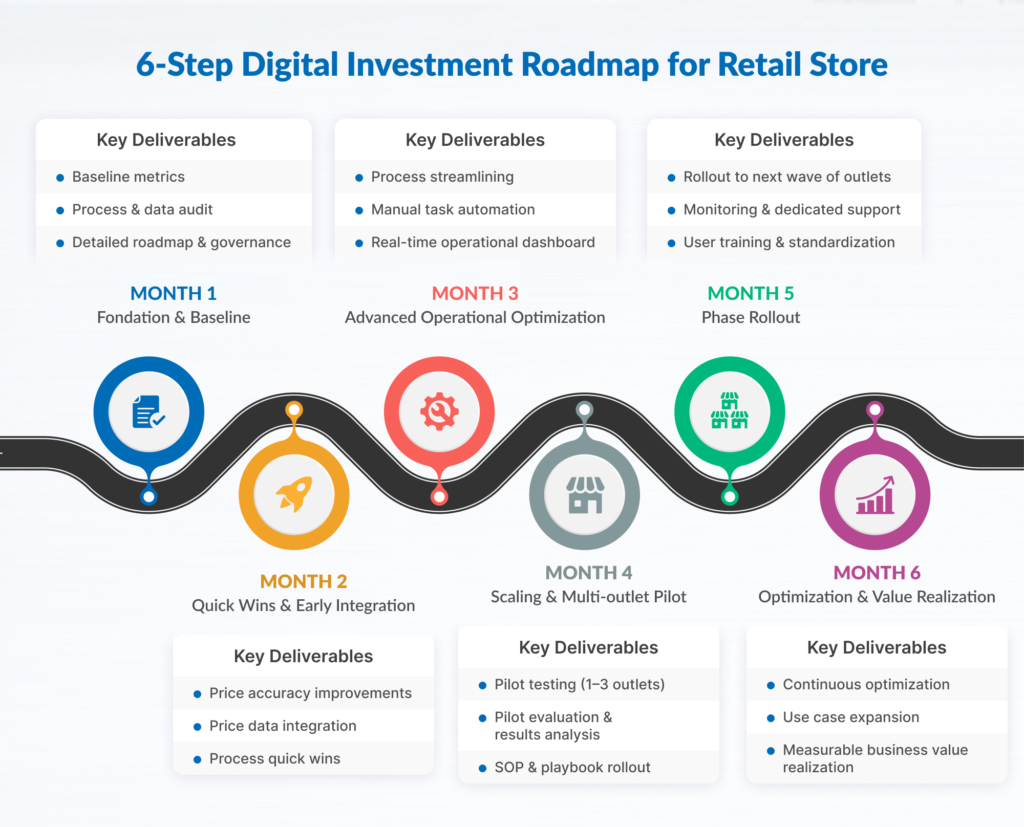
Month 1: Process Audit and Baseline Collection
The primary objective of Month 1 is to establish clear baselines for store operations, inventory management, and pricing accuracy. Without baseline data, calculating Return on Investment (ROI) or validating project success is virtually impossible.
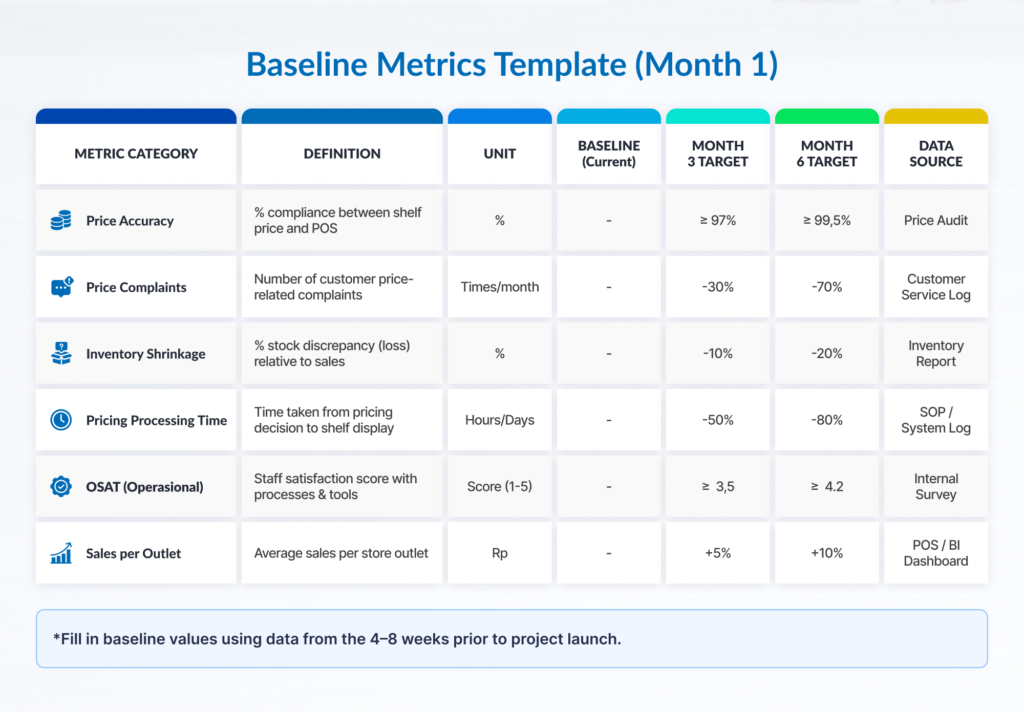
Key Activities:
- Workflow Mapping: Map time-consuming daily processes, such as shelf price tag changes, promotional execution, stock audits, goods receiving, and cashier transaction speed.
- Labor Hour Analysis: Measure the actual time staff spend on repetitive, manual tasks.
- Master Data Audit: Check SKU cleanliness, price consistency between central ERP and local POS, and planogram compliance.
- Infrastructure Inventory: Document local network specifications, bandwidth, port availability, and in-store POS hardware limitations.
- Owner: Retail Transformation Manager
- Contributors: Store Managers, Floor Staff, Retail IT Specialists, Operations Analysts
Output
A comprehensive Process Map document paired with a quantified Baseline Metrics Table.
Success Criteria
For Example, every operational bottleneck has a measurable figure attached (e.g., “Price changes require 14.5 hours per store each week with a 2.8% error rate,” rather than “Price changes take too long”).
Common Pitfall
Skipping the audit phase under the assumption that you “already know the problems.” Without precise baseline numbers, the Month 2 business case will lack credibility with the finance team.
Month 2: Prioritization and Business Case Development
Month 2 focuses on analyzing audit data, setting realistic technology priorities, and securing formal budget approval from top management.
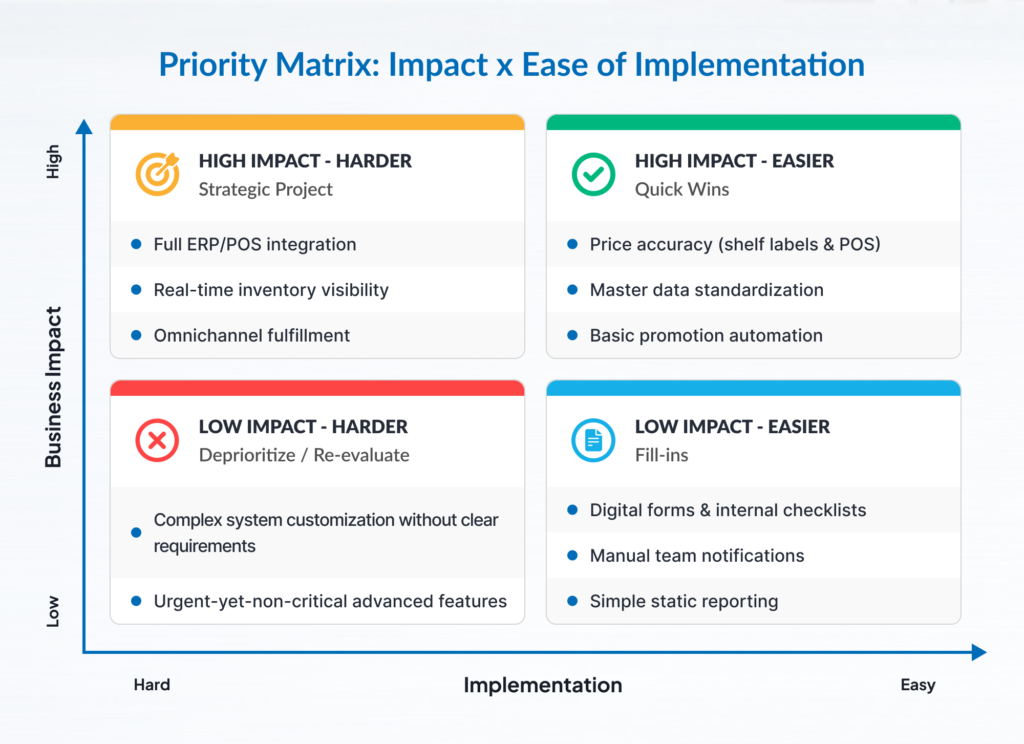
Prioritization Framework: Impact vs. Ease of Implementation
Map all potential technology initiatives onto a 2×2 matrix:
- High Impact / High Ease (Quick Wins): Prioritize for immediate execution in Month 3.
- High Impact / Low Ease (Pilot Projects): Schedule for a controlled pilot phase in Month 4 (e.g., Electronic Shelf Label/ESL integration or automated stock tracking).
- Low Impact / High Ease: Reserve for a secondary efficiency phase.
- Low Impact / Low Ease: Explicitly defer or eliminate from the plan.
Building a Realistic Business Case
Avoid inflated ROI claims from vendors. Base calculations on conservative assumptions:
Estimated Savings=(Manual Hours SavedHourly Wage)+Shrinkage Reduction
Include a full Total Cost of Ownership (TCO) analysis covering software licensing, hardware procurement, network infrastructure upgrades, and staff training costs.
- Owner: Retail Transformation Manager
- Contributors: Chief Financial Officer (CFO), Chief Operating Officer (COO), IT Infrastructure Manager
Output
A 2×2 Priority Matrix document and a formal Business Case Proposal detailing resource allocation, timelines, and projected financial returns.
Success Criteria
Formal sign-off from C-Level sponsors and budget allocation secured for Months 3 through 6.
Common Pitfall
Building a business case based on vendor marketing brochures rather than real operational data collected from stores in Month 1.
Month 3: Quick-Win Execution
The goal of Month 3 is to execute low-risk operational improvements that deliver immediate impact, building trust among store staff and leadership alike.
Characteristics of a True Quick Win:
- Execution completed within approximately 30 days.
- Low technical dependency (no custom coding or complex ERP integrations required).
- Minimal risk of disrupting daily store operations.
- Direct, tangible impact felt by floor staff or customers.
Examples of Quick Win Initiatives:
- Master Data Cleanup: Deactivating obsolete SKUs and aligning pricing data between central ERP and store cash registers.
- Digital Operational Checklists: Replacing paper opening/closing forms with simple mobile forms to improve operational compliance.
- Price Change SOP Standardization: Optimizing workflows and schedules for manual price tag printing to reduce staff overtime.
- Owner: Store Operations Lead
- Contributors: Transformation Manager, Store Managers, Data Admin Team
Output
A 30-Day Quick Win Performance Report comparing pre- and post-execution metrics.
Success Criteria
Achieving a measurable performance lift on target metrics within 30 days (e.g., a 40% reduction in promo prep time at trial stores).
Common Pitfall
Selecting a quick win that requires complex software integration, causing the timeline to stretch for months and killing momentum.
Month 4: Pilot Project in 1–2 Outlets
In Month 4, core technology initiatives are introduced in a controlled environment across 1 to 2 carefully selected retail outlets.
Pilot Outlet Selection Criteria
Select locations that reflect typical operating conditions across your chain. Avoid choosing flagship stores (which have the best facilities) or underperforming locations.
- Average transaction volume.
- Standard network infrastructure setup.
- Cooperative Store Manager with stable staff retention.
Key Execution Focus Areas
- Hardware installation and POS/ERP system integration.
- Intensive floor staff training before system go-live.
- Establishing clear roll-back criteria (a contingency plan in case of critical failure).
- Daily issue logging to capture technical and operational hurdles.
Change Management
Communicate clearly that technology is introduced to simplify work, not replace roles. Appoint floor champions to assist peers in adapting to the new system.
- Owner: Retail Transformation Manager & IT Project Manager
- Contributors: Pilot Store Managers, System Integrators/Vendors, Floor Staff
Output
A Pilot Evaluation Log documenting system uptime, transaction logs, staff feedback, and metric performance versus Month 1 baselines.
Success Criteria
≥99.x% of pre-defined pilot success criteria met during the 4-week trial period (e.g., 0% POS integration error rate, target reduction in price update duration).
Common Pitfall
Providing extra technical support from central headquarters that cannot be replicated during mass rollout, leading to artificially positive pilot results that fail at scale.
Month 5: Evaluation, Standardization, and Playbook Creation
Month 5 centers on analyzing pilot outcomes, refining workflows, and establishing standardized implementation documentation in preparation for multi-store scaling.
Developing the Rollout Playbook
Document solutions for every obstacle encountered during the pilot into a standardized Rollout Playbook, including:
- Location infrastructure and network readiness checklists.
- Technical hardware installation and configuration guides.
- Role-based staff training modules.
- Troubleshooting matrices and escalation pathways.
Refining Financial Models
Update initial business case projections using verified data from the pilot phase. Validated figures from live store environments are far more persuasive to executive leadership when approving full rollout budgets.
- Owner: Transformation Manager & Operations Excellence Lead
- Contributors: IT Systems Administrator, Operations Training Manager
Output
A validated Retail Rollout Playbook and a Multi-Outlet Rollout Budget Proposal backed by actual pilot data.
Success Criteria
Store teams at new locations can independently execute pre-implementation prep using the playbook without requiring direct onsite support from central IT.
Common Pitfall
Expanding across all stores without standardizing SOPs, turning every new branch into an isolated project with ballooning support costs.
Month 6: Phased Rollout and Governance
Month 6 marks the transition from controlled testing to phased implementation across the entire target store network.
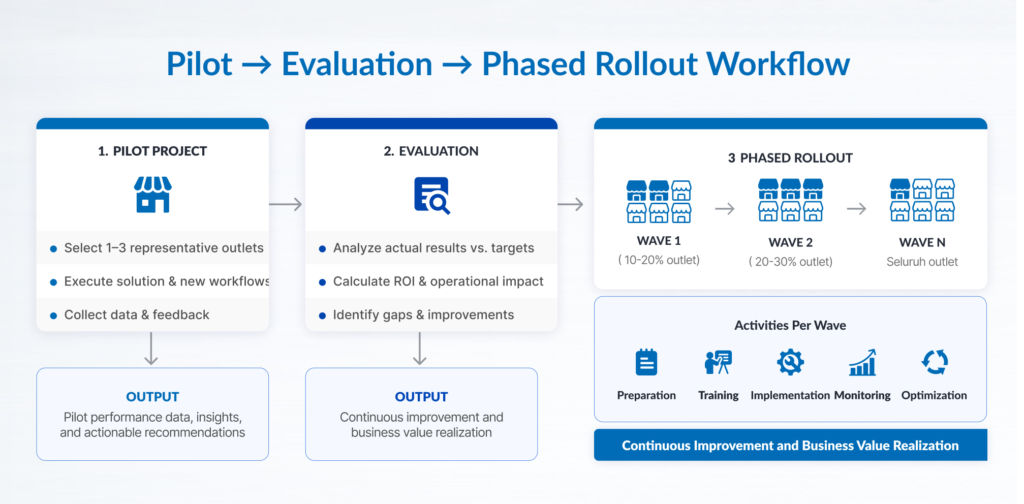
Wave-Based Rollout Strategy
Group remaining outlets into implementation waves based on infrastructure readiness, geographic location, and team capacity – rather than arbitrary regional sequences:
- Wave 1: Outlets with modern infrastructure and stable staff.
- Wave 2: Standard outlets requiring minor network upgrades prior to installation.
- Wave 3: Outlets with physical constraints or remote locations requiring custom handling.
Set a realistic execution throughput (e.g., 3 to 5 stores per week) aligned with IT and vendor capacities.
Long-Term Governance Framework
Establish operational governance structures before closing out the project:
- Assign formal system owners within both Operations and IT divisions.
- Define technical Service Level Agreements (SLAs) with technology vendors.
- Schedule monthly operational metric reviews to ensure long-term compliance.
Owner: Head of Retail Operations & IT Director
Contributors: Transformation Manager, Regional Managers, Field Engineers
Output
A Multi-Store Wave Rollout Schedule accompanied by a Governance Charter and Vendor SLA Agreements.
Success Criteria
Rollout proceeds on schedule without disrupting daily store operations, while newly onboarded outlets hit target efficiency metrics.
Common Pitfall
Treating the project as complete once hardware is installed. Without ongoing governance, staff will gradually revert to legacy manual processes.
Tailoring the Roadmap to Your Business Scale
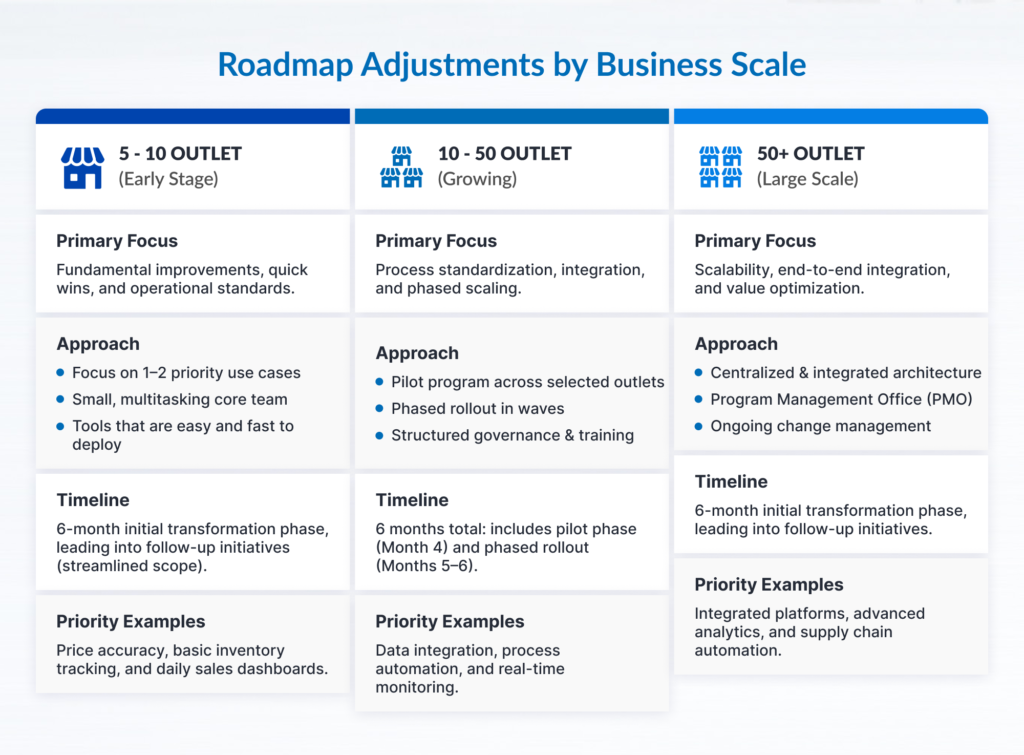
Implementation strategies must scale according to your network size and internal resources:
5–10 Outlets:
- Compressed Timeline: Total duration can be condensed from 6 months to 3–4 months.
- Merged Phases: Combine the Pilot (Month 4) and Standardization (Month 5) phases into a single sequence.
- Core Focus: Prioritize basic POS integration and core inventory automation to establish a flexible foundation.
10–50 Outlets:
- Standard Execution: Follow the full 6-month roadmap as outlined.
- Critical Phase: Month 5 (Playbook Creation) is vital to prevent operational friction during expansion.
- Core Focus: Maintain strict wave execution to keep support workloads manageable.
50+ Outlets:
- Dedicated Team: Form a dedicated deployment team separate from daily IT support staff.
- Extended Schedule: Expand Month 6 into a multi-quarter rollout divided into sub-waves.
- Core Focus: Enforce strict data governance and automated device provisioning before launching mass deployment.
Most Common 6-Month Execution Pitfalls
Use this self-evaluation checklist to detect execution risks throughout your project:
[ ] Procuring hardware before establishing a baseline risks allocating technology budgets without clear operational cost references.
[ ] Running pilot projects without defined success criteria leads to trial phases operating without explicit quantitative targets.
[ ] Skipping master data cleanup causes systems to integrate using duplicate or invalid SKU data.
[ ] Ignoring store staff input yields workflow designs disconnected from store managers’ operational reality.
[ ] Selecting non-representative pilot outlets produces trial results that succeed in flagship stores but fail in standard locations.
[ ] Executing rollouts without a standardized playbook leads to expansion without documented SOPs or troubleshooting steps.
[ ] Failing to assign post-implementation owners leaves operational processes without designated process owners after technical project sign-off.
Retail Store Digitalization FAQ
How long does it take to digitalize a single retail store?
Implementation timelines in retail stores can vary, ranging from a few days to several months per store wave (wave rollout). This duration is heavily influenced by the complexity of the technology architecture, hardware types, master data readiness, logistics efficiency for delivery, and field staff training.
Which technology should be prioritized first?
Prioritize technology that immediately cleans master data and eliminates manual labor hours. For many retailers, operational technologies such as automated price updates, inventory tracking, and POS synchronization can offer more measurable early returns, particularly when baseline data show significant labor, pricing, or inventory inefficiencies.
Does digitalization require replacing the existing POS system?
Not necessarily. Modern retail technology integrates with existing POS systems via Application Programming Interfaces (APIs) or middleware, allowing you to upgrade operational capability without a disruptive core transaction system overhaul.
How do I convince management to approve a digitalization budget?
Build your business case around cost efficiency rather than revenue projections. Use hard data from Month 1 audits to show tangible savings from labor hour reductions, pricing error elimination, and inventory shrinkage prevention.
What is the ideal number of outlets for a pilot project?
For networks of 10–50 stores, select 1 to 2 representative outlets. For larger chains exceeding 100 stores, run pilots across 3 to 5 outlets to test variations in store layout and infrastructure conditions.
What prerequisites are needed before retail technology implementation?
Primary prerequisites include clean SKU master data, stable in-store local networks with sufficient port capacity, secure power supply, and integration access to your POS database, approved integration access to the POS system, such as APIs, middleware, or other supported data interfaces.
Build a Strategic Foundation for Long-Term Digital Retail
The success of retail store digitalization depends on execution order, not just software capability. By starting with a transparent process audit, executing quick wins to build momentum, validating assumptions through pilot projects, and standardizing procedures in a playbook, you can modernize store operations while controlling risk.
Once this 6-month foundation stabilizes, your store network will be positioned to adopt advanced technology layers – from Electronic Shelf Labels (ESL) and AI-powered visitor analytics to unified omnichannel fulfillment models.
Consult Your Retail Digitalization Roadmap
Planning a digital transformation across your retail network? Schedule a free consultation session with our expert team. We are ready to help map your current store operations, identify high-impact quick wins, and establish the right priority sequence for a more profitable technology investment.