


What Is an Electronic Shelf Label and How Does It Work?


An electronic shelf label (ESL) system transforms how brick-and-mortar stores manage pricing by replacing traditional paper tags with automated digital displays.
Imagine a busy grocery store preparing for a massive weekend promotion. Floor staff spend late hours into the night manually swapping hundreds of small paper tags across rows of shelves. Despite their best efforts, several items are missed – leading to frustrated customers and pricing disputes at checkout the following morning.
This scenario highlights the primary vulnerability of legacy retail setups: manual paper pricing is slow, labor-intensive, and prone to human error. Digitalizing price management solves this issue at its root. In this guide, you will learn what electronic shelf labels are, how the underlying technology operates, core system components, key business benefits, and critical considerations before adopting ESL technology in your retail infrastructure.
What Is an Electronic Shelf Label (ESL)?
An electronic shelf label (ESL) is a battery-powered digital display unit attached to retail shelves. It automatically updates product prices and merchandise information in real time via a wireless network connected to a store’s central Point of Sale (POS) or enterprise database.
To visualize how it works on the shop floor, think of an ESL as a small e-paper screen mounted right where your product sits. Just as an e-reader displays crisp text without harsh backlighting, an ESL renders prices, barcodes, and product details clearly under bright store lighting.
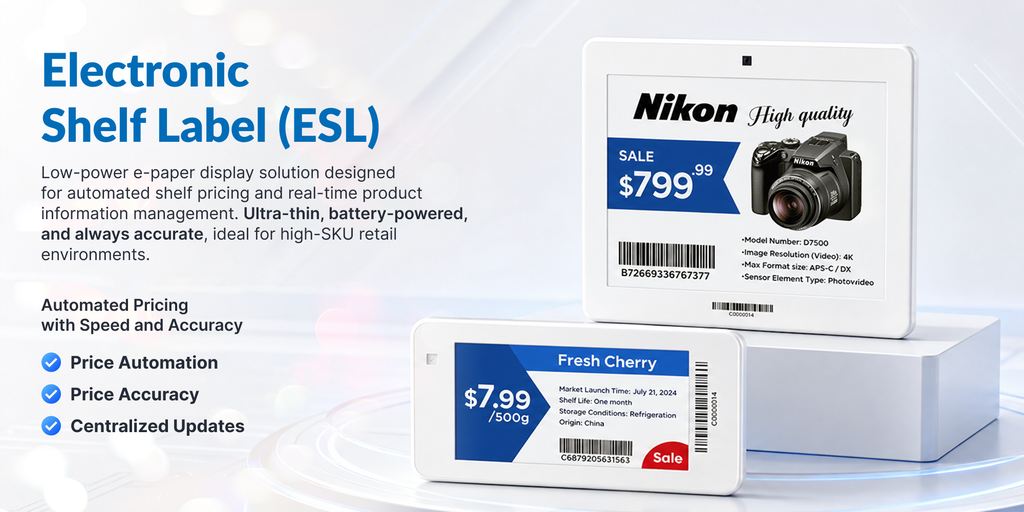
First popularized in Europe during the 1990s, ESL technology was adopted by grocery giants seeking to cut label printing costs. Early iterations relied on basic liquid crystal displays (LCDs) with narrow viewing angles and short battery life. Today, modern systems feature advanced Electronic Ink (E-Ink) micro-displays paired with secure wireless protocols. As commercial retail networks across Southeast Asia rapidly expand, ESL adoption has evolved from an experimental luxury into an essential operational standard.
Beyond the Shelf Edge: Modern Applications of ESL Technology in Retail
Understanding where each digital display technology fits into your retail infrastructure requires evaluating its primary role, optimal placement, and operational impact across different store zones.
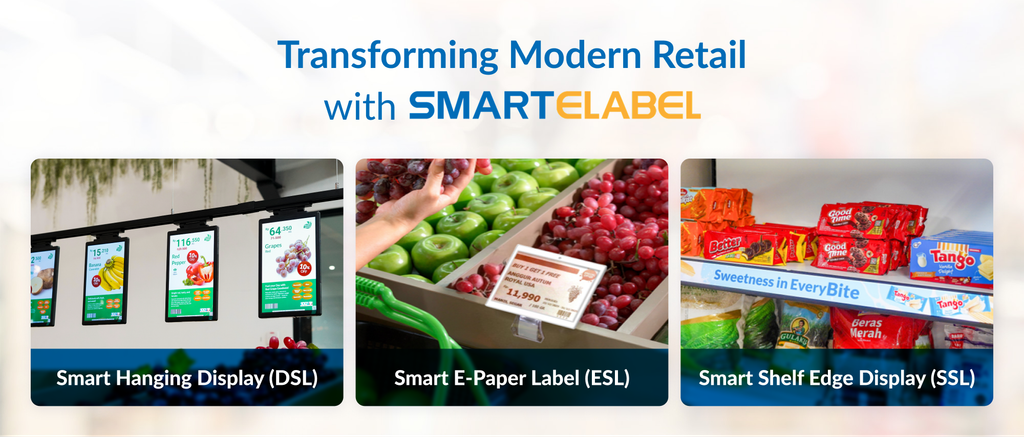
Electronic Shelf Label (ESL)
The core concept of the Electronic Shelf Label focuses on high-volume price automation. Installed across standard product shelf edges throughout all main aisles, ESL tags serve as the operational workhorse for storewide price management. By replacing manual paper tag swapping with automated wireless updates, this technology eliminates pricing errors, reclaims hundreds of labor hours every month, and guarantees complete price synchronization between the physical shelf and the POS system in real time.
Digital Price Display / LCD Price Tag
Unlike standard E-Ink ESL tags, Digital Price Displays leverage high-resolution, full-color LCD screens to drive dynamic pricing alongside eye-catching visual promotions. These displays are best deployed on featured product racks, endcaps, and high-value merchandise sections where visual impact directly drives conversion. Their bright screens capture shopper attention instantly, allowing retailers to execute time-sensitive price changes (such as hourly flash sales or promotional discounts) while significantly boosting product appeal right at the shelf edge.
Smart Shelf Edge Display (SSL) / Digital Shelf Display
Smart Shelf Edge Displays function as continuous digital media strips built for interactive brand communication and rich in-store messaging. Installed along high-visibility promotional shelf strips and featured category rows, these displays transform basic shelf rails into high-impact digital advertising space. By rendering motion video advertisements, animated promotional banners, and detailed product specs right at the point of purchase, SSL technology actively engages shoppers to drive cross-selling and upselling opportunities.
A Quick Comparison of the Retail Display Technologies
| Solution | Primary Role | Primary Fit / Placement |
| Electronic Shelf Label (ESL) | High-volume price automation | Standard retail aisles across high-density SKUs |
| Digital Price Display | Dynamic pricing & visual promotion | Endcaps, featured product racks, and high-value sections |
| Smart Shelf Edge Display (SSL) | In-store digital media & brand engagement | High-visibility promotional shelf strips and category leads |
Core Components of an ESL System
An electronic shelf label system operates as an integrated ecosystem comprising hardware, wireless communications, and central software management.
- ESL Tag / Label: The physical tag mounted on the shelf edge features an ultra-low-power Electronic Paper (E-Paper) screen. Powered by long-lasting industrial coin cell batteries, these tags operate for 5 to 10 years without replacement. Displays range from compact 1.6-inch tags for small cosmetics or pharmacy items up to large 7.5-inch displays for electronics or produce sections. Color options include classic black-and-white, three-color (black, white, red/yellow), and full-color displays.
- Wireless Gateway / Access Point: The gateway acts as the communication bridge between central server software and thousands of active shelf tags. Installed on store ceilings or structural beams, a single gateway uses radio frequencies (typically 2.4 GHz RF, sub-GHz, or specialized optical signals) to transmit pricing instructions across hundreds of square meters.
- Software Management System: This central interface manages price templates, schedules promotional updates, monitors tag battery levels, and tracks display connectivity. Store managers can update thousands of product prices across multiple branches simultaneously using a central dashboard.
- POS / ERP Integration: The Point of Sale (POS) or Enterprise Resource Planning (ERP) database serves as the ultimate source of truth for pricing. When pricing analysts alter a product price in the central database, the ESL software ingests this change automatically to ensure complete pricing consistency.
- Network Infrastructure: Local Area Networks (LAN) or secure Wi-Fi connections handle data transfer between local store gateways and central cloud or on-premise servers.
How Does an Electronic Shelf Label Work?
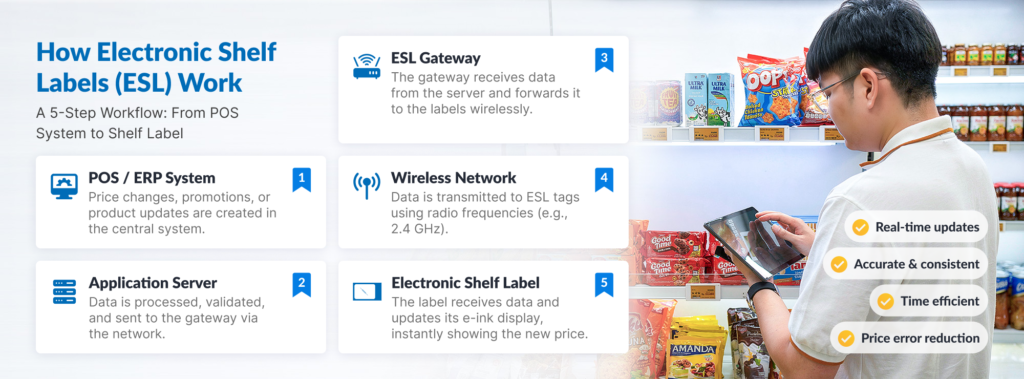
The journey of a price update from corporate headquarters down to an individual shelf edge follows five automated steps:
- Price Change Entry: A merchandiser or manager updates a product price inside the main POS or ERP database.
- Data Transfer to Middleware: Updated price data pushes automatically through an API integration into the ESL management software.
- Instruction Dispatch: The ESL software identifies the specific tag ID assigned to that SKU and routes update instructions to the corresponding store gateway.
- Wireless Broadcast: The ceiling-mounted gateway broadcasts an encrypted wireless signal carrying the updated graphic array to the target tag.
- Screen Refresh & Sleep Mode: The physical tag receives the data packet, alters its electronic ink micro-capsules to show the new layout, sends a receipt confirmation back to the gateway, and immediately reverts to low-power sleep mode.
Core Technical FAQ: How ESL Functions on the Shop Floor
Why use E-Ink displays instead of standard LCD screens?
Electronic Ink mimics real paper. Unlike traditional smartphone screens that constantly emit light and drain battery power, E-Ink uses micro-capsules suspended in liquid. Electrical charges move colored pigments to the surface, creating crisp, non-glare text and images.
Operational Impact: Line-of-sight visibility remains sharp under harsh store lighting from wide angles, and the display draws zero electrical current except during the exact second the screen image changes.
How long does the price update process take?
Updating an individual tag takes mere seconds. Transmitting pricing across thousands of SKUs takes anywhere from a few seconds to a few minutes, depending on network capacity and transmission frequency.
Operational Impact: Store teams can execute flash sales, daily dynamic price changes, or storewide overhauls in minutes, replacing a manual process that typically takes hours or days.
Does an ESL system require a constant internet connection?
No. Physical shelf tags rely on direct radio signals from local store gateways rather than an external internet connection. However, the central gateway requires stable Local Area Network (LAN) access to ingest database updates from your management software.
Operational Impact: If external internet connectivity drops temporarily, your shelf tags continue displaying accurate current pricing without interruption.
Key Benefits of Electronic Shelf Labels
Transitioning to automated digital shelf labels delivers measurable advantages across daily retail operations:
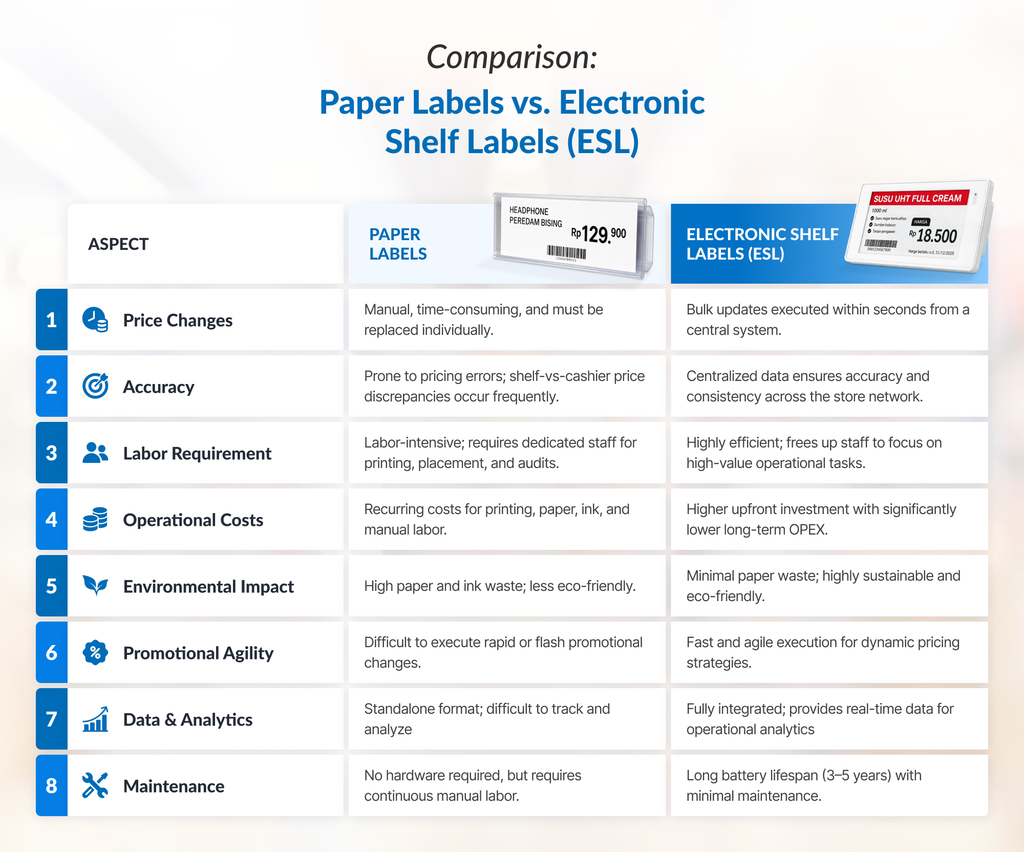
- Operational Efficiency: Manual price changes require staff to print paper sheets, cut individual labels, walk store aisles, locate SKUs, pull old tags, and insert new ones (averaging 30 to 50 paper tags per hour). ESL systems update thousands of tags automatically in seconds – reclaiming hundreds of labor hours per store every month for customer service, restocking, and store maintenance.
- Price Accuracy & Reduced Dispute Costs: Discrepancies between shelf prices and cash register scanners create customer distrust and potential regulatory fines. ESL updates guarantee that the price shown on the shelf matches the POS database at all times, reducing manual checkout overrides and long cashier queues.
- Dynamic Pricing Agility: Modern omnichannel retail demands flexible pricing strategies – such as lowering prices on fresh produce late in the evening to reduce food waste, matching competitor online pricing instantly, or running flash sales. ESL allows instant response to market trends without waiting for physical label distribution.
- Environmental Sustainability: A medium-sized supermarket burns through 30,000 to 100,000 paper tags, plastic holders, and adhesive stickers annually. Adopting ESL eliminates recurring paper and ink consumption, supporting eco-friendly corporate initiatives while cutting recurring consumable costs.
- Enhanced Omnichannel Operations: Modern multi-segment ESL displays show more than retail prices; they display live stock levels, reorder alerts, planogram locations, and QR codes for shoppers to scan for detailed product specs. E-commerce fulfillment staff can pick orders directly from retail shelves faster and with higher accuracy.
Paper Labels vs. Electronic Shelf Labels
Types of Businesses Best Suited for ESL
While any retail business benefits from price automation, specific retail sectors experience the highest return on investment:
- Supermarkets & Hypermarkets: High SKU counts, frequent promotional rotations, and perishable items requiring rapid pricing updates benefit immediately.
- Chain Convenience Stores: High outlet counts with lean store staff make manual updates inefficient; central ESL management ensures network-wide compliance instantly.
- Pharmacies & Beauty Stores: Small items packed tightly on shelves make manual labeling tedious; small-format ESL tags fit compact shelf edges cleanly while displaying detailed unit pricing.
- Electronics & Appliance Outlets: High-value items with fluctuating market prices require detailed spec listings and QR code links to product sheets that large-format ESL displays present clearly.
- Hardware & Building Supply Centers: Fast-changing commodity rates for construction materials require quick pricing adjustments across large floor spaces.
- Warehouses & Logistics Hubs: Digital tags attached to storage racks streamline inventory picking, display live stock counts, and update bin locations dynamically.
Key Considerations Before Adopting ESL
Implementing ESL technology requires strategic upfront planning to maximize long-term efficiency:
- Initial Investment vs. Long-Term ROI: While digital tags carry higher upfront capital expenditure than paper stock, focus your evaluation on Total Cost of Ownership (TCO). Labor cost savings, waste elimination, and improved pricing accuracy typically deliver positive financial returns within 12 to 24 months.
- SKU Count and Store Layout: The physical dimensions of your store network and total active SKUs dictate network architecture. High ceilings or multi-level floors require strategic placement of wireless access points to eliminate signal dead zones.
- Existing POS/ERP Integration: Your current POS database must support data output via modern APIs or database connectors. Ensuring your software setup interfaces cleanly with ESL management middleware is a critical early step during vendor evaluations.
- Staff Training & Change Management: Floor staff must learn basic operational workflows – such as pairing new tags to SKUs using mobile handheld scanners, replacing mounting clips, and reading diagnostic tag indicators.
- Technical Support & Warranties: Select vendors offering commercial warranties covering tag battery operational lifespans alongside reliable local technical support to ensure uninterrupted performance.
Frequently Asked Questions (FAQ)
How long does an ESL battery last?
Most commercial ESL tags operate for 5 to 10 years on standard industrial coin cell batteries. Overall lifespan depends on display size, operating environment temperature, and frequency of daily screen updates (typically calculated at 3 to 4 refreshes per day).
Can ESL be integrated with an existing POS system?
Yes. Modern ESL management software connects directly with leading POS and ERP databases using standardized API connections, CSV transfers, or database middleware. This structure ensures that any price updated in your core POS system pushes across your physical shelf displays automatically.
Are ESL tags waterproof and cold-resistant for freezers?
Specialized freezer-rated ESL models exist specifically for cold storage environments. Standard tags operate between 0°C and 40°C, while freezer tags utilize specialized low-temperature batteries and sealed IP65/IP67 water-resistant casings that function reliably down to -25°C without screen fogging or battery failure.
Can ESL displays render QR codes and promotional graphics?
Yes. Modern E-Ink tags feature multi-segment layout customizable templates. Retailers can render high-contrast black-and-white or three-color (black, white, red/yellow) QR codes, stock numbers, unit pricing, planogram codes, promotional icons, and discount badges directly on the tag face.
How many labels can a single gateway manage?
A single industrial ESL wireless gateway manages between 2,000 and 10,000 individual tag displays, depending on store layout, physical barrier interference, ceiling height, and vendor hardware specifications. Larger retail spaces simply add extra gateways across the ceiling grid.
Is ESL suitable for small stores with only 1–2 outlets?
Yes. While enterprise chains gain massive centralized efficiencies, independent stores operating high SKU volumes or frequent price updates still benefit significantly. Small retailers can deploy simplified plug-and-play ESL starter setups with a single access point to lower labor pressure on small floor teams.
Conclusion
Electronic shelf label systems represent far more than a visual upgrade for store shelf edges, but a foundational infrastructure for modern automated retail management. By replacing manual paper processes with real-time wireless digital displays, retail businesses reduce operational overhead, eliminate costly cashier pricing errors, and achieve the agility needed for dynamic pricing strategies.
As customer expectations evolve toward seamless omnichannel experiences, maintaining accurate, flexible pricing across physical store shelves is essential. Adopting digital shelf automation helps ensure your retail operations remain scalable, efficient, and competitive in a digital-first marketplace.
Want to take your store operations to the next level? Explore how Electronic Shelf Labels (ESL) boost efficiency and agility, or consult our specialist team today to find the right solution for your retail network.