When evaluating Electronic Shelf Label (ESL) solutions, procurement and retail IT teams often receive vendor proposals with completely different structures. Some vendors highlight low per-label costs while others emphasize software features, and the quotation structure for each vendor tends to differ, making it difficult to compare them on an apples-to-apples basis.
However, an ESL implementation is not a simple hardware purchase; it is a multi-year operational commitment. Over a five-year lifecycle, system reliability, network coverage, and post-implementation support carry far more weight than the initial purchase price.
This guide provides an objective evaluation framework, including specific questions and red flags, designed to help you build your Request for Proposal (RFP) or internal vendor scoring matrix. As a leading retail technology integration partner in Indonesia, PT Murni Solusindo Nusantara encourages retail teams to submit these exact questions to every vendor under consideration – including us.
Key Evaluation Criteria at a Glance
- Vendor viability assesses a provider’s local track record and operational continuity to ensure lasting hardware support.
- Service networks and SLAs guarantee field support speed across multi-store locations to prevent costly operational downtime.
- Integration capabilities check POS and ERP software compatibility to sync digital shelf prices with checkout counters.
- Hardware lifecycle and quality evaluate overall build durability and battery integrity to reduce long-term replacement costs.
- TCO transparency uncovers all recurring, maintenance, and hidden fees to prevent unexpected budget surprises.
- Phased deployment support uses pilot testing and staged rollouts to minimize operational implementation risks.
- Data security and governance demand strict compliance with international security standards to protect core pricing databases.
- Exit strategy and data ownership secure data portability to avoid long-term vendor lock-in risks.
Why Evaluating ESL Vendors Differs from Standard Hardware Procurement
Procuring Electronic Shelf Labels differs fundamentally from buying static store fixtures or standalone hardware. Once installed, ESL systems become deeply embedded into daily store operations and core pricing workflows.
Because of these factors, procurement decisions must prioritize long-term operational capabilities over short-term price discounts.
Eight Essential Evaluation Criteria for ESL Vendors
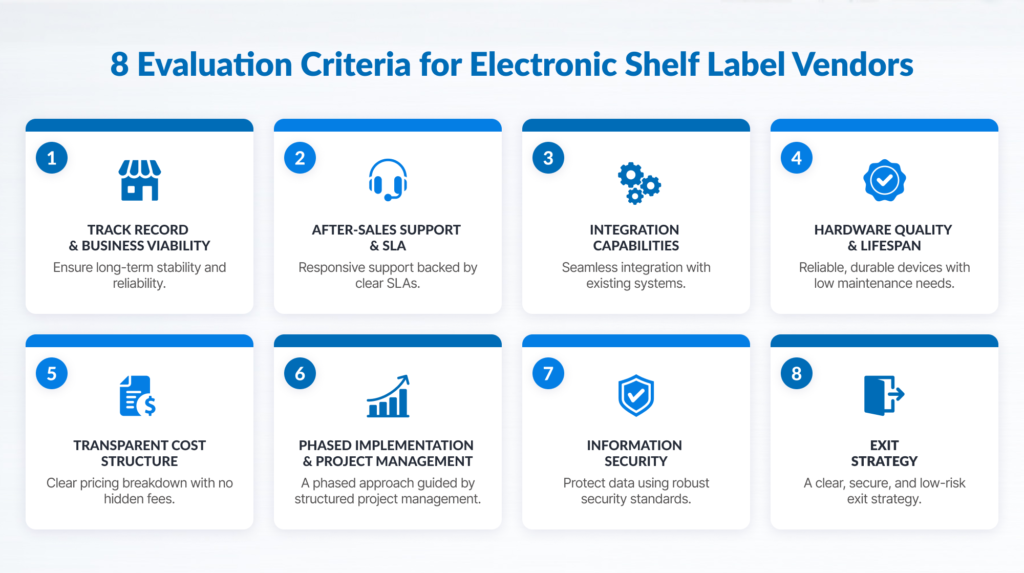
Each section below outlines why the criterion matters, what specific questions to ask, and the warning signs to watch for during vendor evaluations.
1. Vendor Track Record and Business Continuity
Why it matters: ESL hardware has an extended operational life. If a technology partner exits the market or discontinues support, your retail network is left with unsupported infrastructure and unreplaceable components.
Questions to Ask:
- How long has your organization provided retail technology solutions in Indonesia?
- How many active ESL deployments are you currently supporting locally?
- Can you provide client references operating a store network of similar scale?
Red Flags:
- Inability or reluctance to provide verifiable local client references.
- Operational track record based entirely on overseas deployments without direct local infrastructure.
2. Post-Sales Service Coverage and SLA Commitments
Why it matters: For multi-store retail networks across different cities, service resolution speed dictates whether store pricing operations run smoothly or suffer long downtime periods.
Questions to Ask:
- How many direct service points do you operate, and in which cities are your field engineers located?
- What are your guaranteed response and resolution Service Level Agreements (SLAs), and are they explicitly defined in the contract?
- How are support tickets handled for regional stores outside major metropolitan areas?
Red Flags:
- SLAs stated verbally during sales presentations but omitted from legal contracts.
- Technical support concentrated in a single city despite claiming national coverage.
- Vague responses regarding field support response times for non-capital locations.
3. Integration Capabilities with Existing Infrastructure
Why it matters: Integration is a critical area in ESL implementation projects, as the system is required to sync price data across POS, ERP, and other data sources used by the retailer. The software platform must sync smoothly with your existing pricing databases, POS platforms, and ERP systems.
Questions to Ask:
- What integration methods (APIs, middleware, direct database connectors) does your software platform support?
- Has your technical team successfully integrated with our specific POS or ERP system in past projects?
- Who manages and maintains the integration middleware after system go-live?
- Is comprehensive API and technical documentation available for internal audit?
Red Flags:
- Claims of universal “plug-and-play” compatibility without requesting technical specifications of your current IT architecture.
- Failure to provide technical documentation or API specifications upon request.
4. Hardware Quality and Component Lifespan
Why it matters: Replacement costs at the end of hardware life significantly impact the Total Cost of Ownership. Labels must withstand varied retail environments, from standard ambient shelves to high-humidity or cold-storage zones.
Questions to Ask:
- What testing standards determine the estimated operational lifecycle of your display labels?
- How do your labels perform in cold, humid, or high-traffic store environments?
- What is the guaranteed availability period for spare parts and replacement labels?
- What specific conditions are covered under your standard and extended hardware warranties?
Red Flags:
- Lifespan claims made without contextual data (such as daily update frequency or operating temperature assumptions).
- Lack of structural clarity regarding long-term spare part availability.
5. Transparent Cost Structure
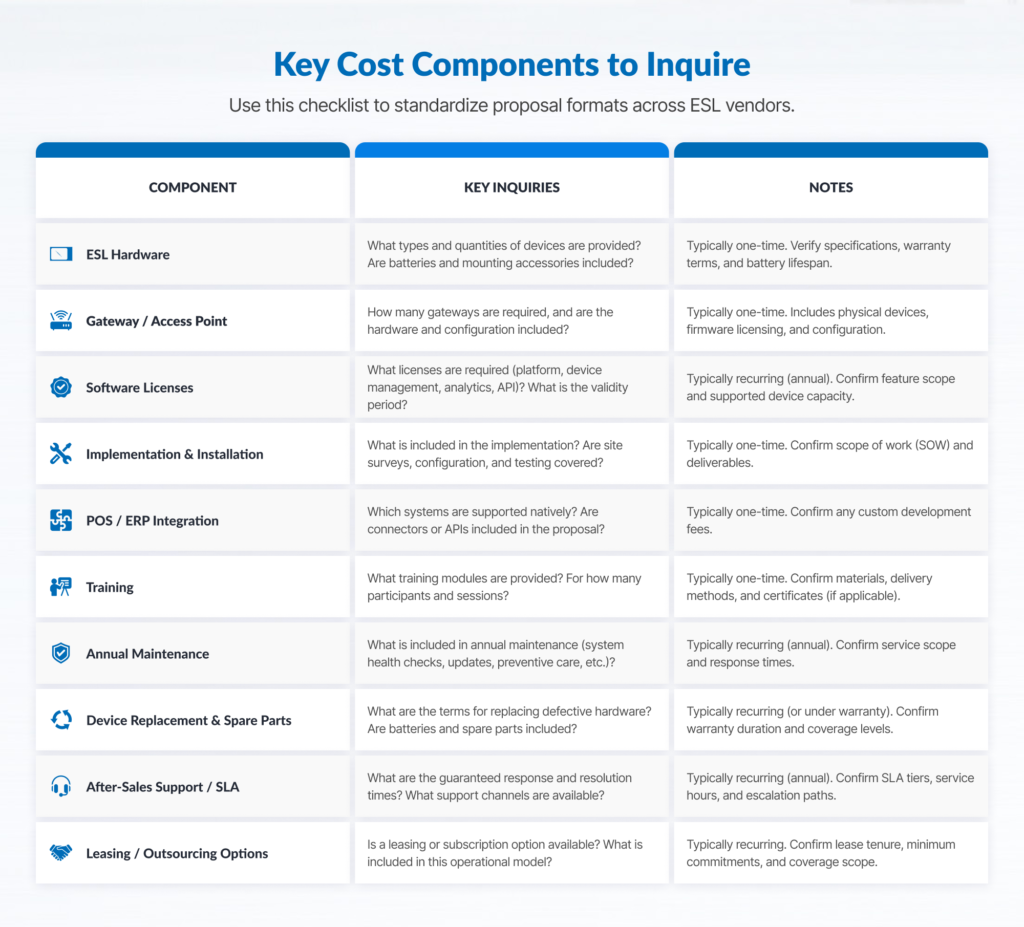
Why it matters: Initial proposals often highlight per-unit label costs while omitting infrastructure, software licensing, or ongoing maintenance expenses. Evaluating proposals requires standardizing all cost components across vendors.
Questions to Ask:
- What components make up the total implementation cost (hardware, access points/gateways, software licenses, installation, integration, training)?
- Are software licensing fees fixed, per-label, or subscription-based?
- What are the recurring annual maintenance and support costs post-warranty?
- Do you offer capital expenditure (CapEx) purchase options as well as leasing or operational expenditure (OpEx) models?
Red Flags:
- Proposals providing only a line-item price per label while deferring software or service costs to later stages.
- Unclear recurring software or infrastructure maintenance fees.
Vendor Cost Structure Checklist
Use this framework to standardize cost components across incoming vendor proposals:
| Cost Component | Included Upfront? (Yes/No) | Pricing Structure (Fixed / Recurring) | Notes / Dependencies |
| ESL Hardware (Displays) | Per Unit | Size, screen type, mounting accessories | |
| Wireless Gateways / APs | Per Unit | Based on store coverage and layout | |
| Central Management Software | Perpetual / Subscription | On-premise vs. Cloud hosting | |
| POS / ERP Integration | One-time / Service Fee | Custom connector vs. standard API | |
| On-Site Installation & Setup | Project Fee | Store count, labor, after-hours rates | |
| Store Admin & Staff Training | Project Fee | Administrative & store-level training | |
| Annual Maintenance (SLA) | Recurring Annual | Coverage level and response time tiers | |
| Out-of-Warranty Replacement | Rate Card | Spare parts catalog pricing |
6. Phased Rollout Support and Project Management
Why it matters: Deploying hardware across tens or hundreds of retail locations simultaneously carries high operational risk. A structured, phased rollout minimizes business disruption.
Questions to Ask:
- Do you support a structured pilot implementation in a single store before full network commitment?
- Will a dedicated project manager be assigned to oversee system deployment?
- What is the projected rollout timeline per store wave, and what factors determine that schedule?
- What contingency protocols exist if deployment schedules face delays?
Red Flags:
- Vendors pushing for immediate, full-network rollouts while discouraging pilot store testing.
- Absence of a named project management team or documented deployment methodology.
7. Information Security and Data Governance
Why it matters: ESL management software connects to core operational databases and updates live product pricing across physical stores. Insecure management platforms introduce operational vulnerabilities.
Questions to Ask:
- What standards or security certifications do the vendor, ESL platform, and hosting infrastructure hold?
- What data elements does the ESL platform access, and where is that data stored or processed?
- How are remote technical support access and administrative credentials controlled and audited?
- What are your documented procedures in the event of a security incident or system outage?
Red Flags:
- Unable to provide verifiable proof of security controls, including relevant certifications, third-party assessment results, or security control documentation.
- Lack of documented protocols regarding access control and technical support auditing.
8. Clear Exit Strategy and System Portability
Why it matters: An often-overlooked criterion during initial procurement is how easily your organization can transition if operational requirements change years down the line.
Questions to Ask:
- Upon contract termination, how is operational data exported and transitioned back to our IT team?
- Are display labels bound strictly to your proprietary management software, or can hardware run on open standards?
- What options exist for adding stores independently in the future?
Red Flags:
- Dismissive responses regarding contract exit terms or data transition procedures.
- Rigid proprietary structures designed to limit future system flexibility.
Vendor Evaluation Scoring Matrix
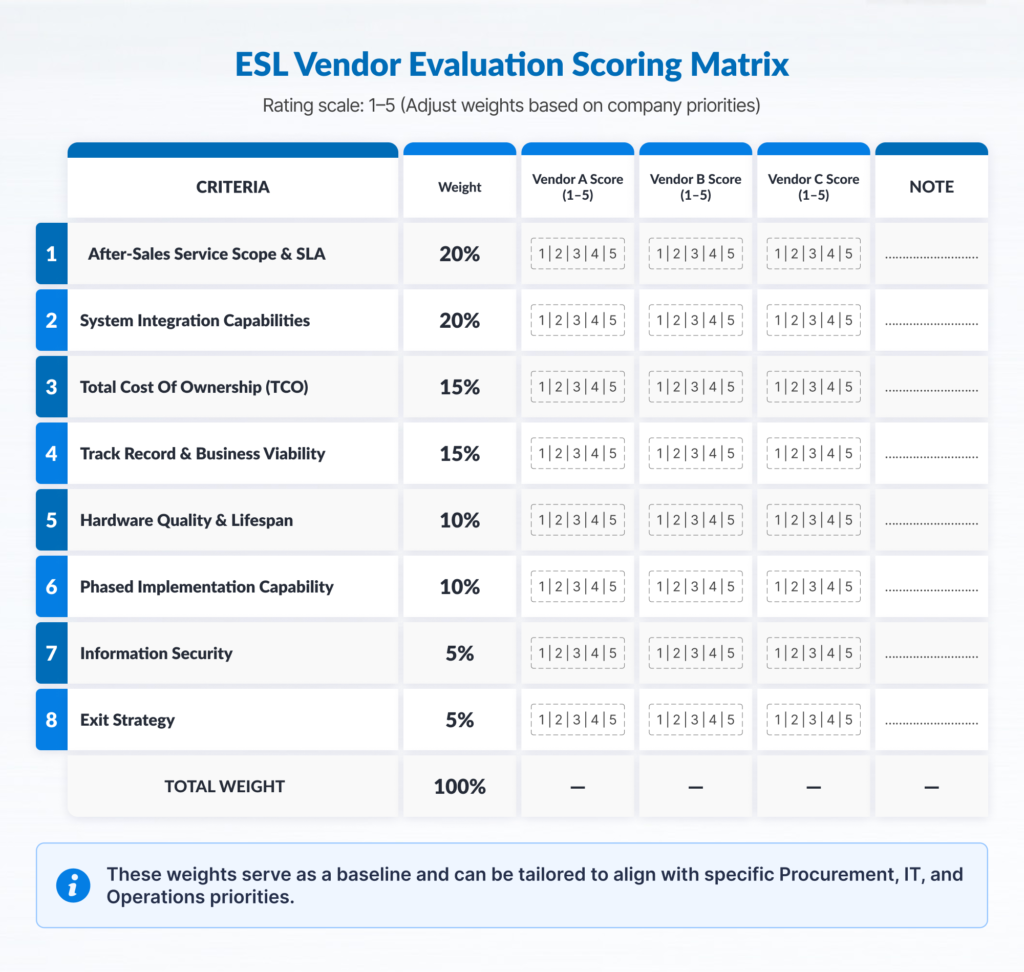
To ensure a fair and defensible selection process, use a weighted scoring model. Combine inputs from Procurement, Retail Operations, and IT departments.
| Evaluation Criterion | Recommended Weight | Vendor Score (1–5) | Weighted Score |
| Post-Sales Service Network & SLA | 20% | ||
| System Integration Capability | 20% | ||
| Total Cost of Ownership (TCO) | 15% | ||
| Vendor Viability & Track Record | 15% | ||
| Hardware Lifespan & Build Quality | 10% | ||
| Phased Implementation Support | 10% | ||
| Information Security & Governance | 5% | ||
| Exit Strategy & Data Ownership | 5% | ||
| Total Score | 100% |
Note: Weighting percentages serve as a baseline model. Multi-store networks with widespread geographic footprints should consider increasing the weight for Service Network & SLA, while organizations with legacy enterprise IT environments may increase the weight for System Integration Capability.
Why Comparing ESL Quotations Directly Is Challenging
When reviewing financial proposals from multiple suppliers, procurement teams often find that pricing structures vary significantly. Understanding why proposals differ helps avoid unexpected long-term costs.
Practical Recommendation: Require all participating vendors to complete a standardized cost component matrix (such as the table provided in Criterion 5). Evaluate proposals over a projected 5-year operational lifecycle rather than comparing initial CapEx quotes alone.
Evaluation Red Flags Summary
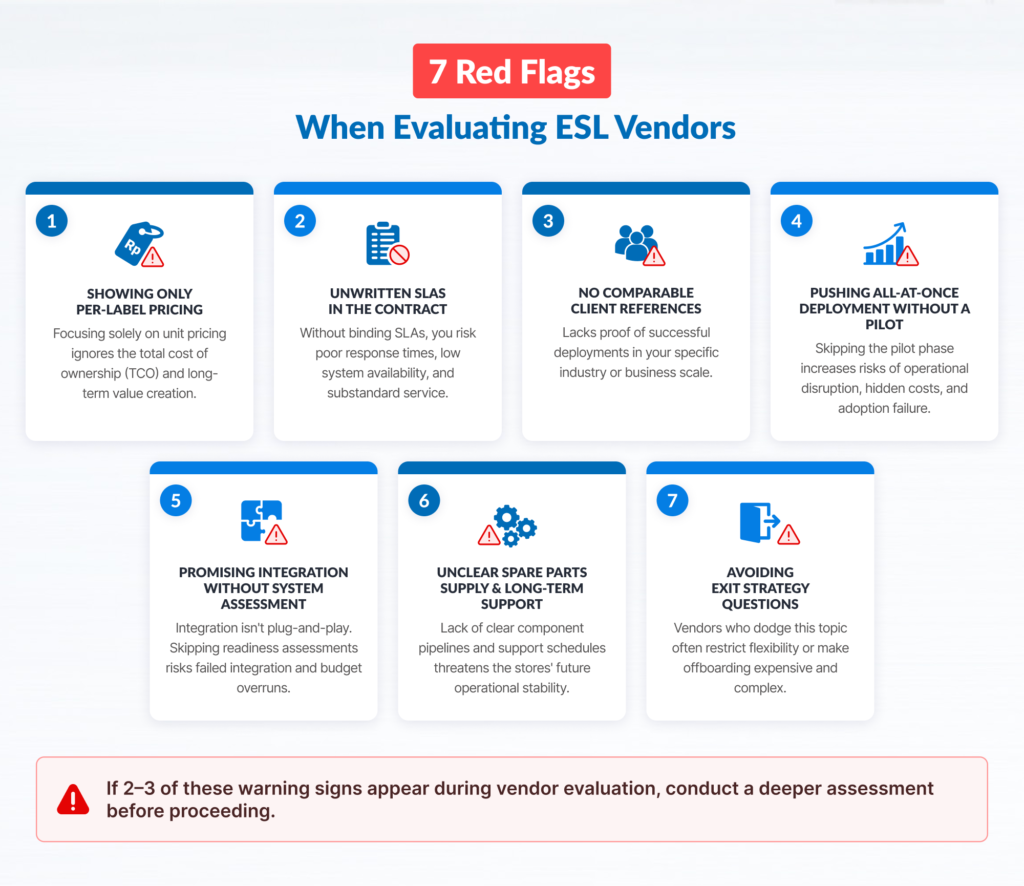
Keep this quick-reference warning list accessible during vendor presentation rounds:
- Incomplete Financial Quotes: Proposals providing per-label prices without explicit installation, middleware, or service costs.
- Unwritten SLA Terms: Service level guarantees communicated verbally but missing from contractual terms.
- Lack of Scaled References: Inability to provide reference clients with comparable store counts and geographic distribution.
- Bypassing the Pilot Stage: Pushing for immediate multi-store commitment while discouraging a pilot store trial.
- Vague Integration Plans: Promising seamless connectivity without reviewing existing POS or ERP system documentation.
- Unclear Component Availability: Lack of written guarantees regarding spare label availability over time.
- Evasive Exit Terms: Reluctance to define data ownership and system transition protocols upon contract completion.
Final Verification Steps Before Contract Awarding
Before finalizing a contract with your selected vendor, execute these final verification steps:
- Deploy a Stress-Test Pilot: Conduct a pilot deployment in your most operationally challenging store location (e.g., high-volume turnover, difficult wireless environment, or cold-storage areas) rather than your easiest location.
- Test Failure Scenarios: Evaluate how the vendor’s software handles disconnected network nodes, power disruptions, and bulk price updates during high-traffic periods.
- Contact Client References Directly: Reach out directly to past implementation references. Ask specifically about post-sales SLA compliance, field service responsiveness, and hardware failure rates over time.
- Contractualize Operational Commitments: Ensure all verbal commitments – especially regarding support SLAs, spare part availability timelines, and integration responsibilities – are explicitly incorporated into the final master service agreement.
- Define Clear Project Acceptance Metrics: Establish written criteria for operational sign-off prior to beginning multi-store deployment.
Frequently Asked Questions
How many vendors should we evaluate in an ESL procurement process?
Evaluating three to four qualified vendors provides a balanced view of market capabilities without overwhelming your evaluation team. Ensure all vendors complete the same standardized technical and cost framework to keep comparison straightforward.
Should multi-store retailers prioritize local or global vendors?
The origin of the vendor matters less than their local field infrastructure. Global software platforms require strong local system integration and field engineer support to manage multi-store operations across Indonesian cities effectively.
Can per-label hardware cost be used as the primary selection metric?
No. Per-label costs represent only a portion of the total investment. Infrastructure, integration, central software, and long-term maintenance impact the operational budget far more over a multi-year deployment lifecycle.
Is a pilot store implementation strictly necessary?
Yes. A pilot store trial validates wireless coverage, integration stability with your POS/ERP, and operational workflows under real retail conditions, preventing costly adjustments during full network deployment.
What specific terms must be defined in an ESL Service Level Agreement (SLA)?
An effective SLA specifies clear response and resolution times categorized by ticket severity, rules for on-site engineer dispatch across regional stores, hardware replacement terms, and maintenance window schedules.
How should we evaluate a vendor that lacks experience in our specific retail segment?
Focus on their underlying technical capability, software flexibility, security standards, and field support footprint. Require a pilot implementation to verify that their team can meet your specific operational workflows.
Is it better to purchase ESL infrastructure outright or lease it?
Both models are viable. Outright purchase (CapEx) lowers long-term costs if capital is available. Leasing or managed service options (OpEx) preserve initial capital and combine hardware, software, and maintenance into a single predictable operational cost.
Select Your ESL Partner with Confidence
Choosing an ESL vendor is an investment in your retail network’s operational infrastructure for years to come. Focus your evaluation on long-term system stability, integration quality, and nationwide service coverage rather than short-term price discounts.
We invite you to apply the criteria, questions, and scoring frameworks in this checklist to every vendor you consider – including PT Murni Solusindo Nusantara.
Established in 1992, PT Murni brings over 34 years of experience as an enterprise technology solution provider in Indonesia. Supported by 700+ employees, 300+ field engineers, and over 100 service points nationwide, we provide robust technical architecture, centralized SLA-backed support, and flexible procurement models (CapEx and leasing).
Our operations adhere to strict international standards, backed by ISO 9001:2015, ISO 27001 (Information Security Management), ISO 27701 (Privacy Information Management), and ISO 22301 (Business Continuity Management) certifications.
Ready to evaluate your options?
Schedule a Vendor Consultation with our retail technology specialists to review your evaluation checklist, or Book a Live System Demo to test our ESL integration capabilities firsthand.