


7 Common Operational Issues in Multi-Branch Businesses


Expanding your branch network creates new growth opportunities, but multiplies operational challenges. As your footprint grows, maintaining consistent service standards, data visibility, staff efficiency, and operational control becomes increasingly difficult, and small friction points quickly turn into systemic bottlenecks.
Managing a multi-site network requires bridging the gap between local branch execution and central executive control. Drawing from field data across retail, banking, healthcare, and service sectors, businesses scaling beyond their initial footprint face seven predictable operational hurdles. Here is a breakdown of those challenges, their root causes, and how to address them effectively.
Quick Overview: 7 Multi-Branch Operational Issues
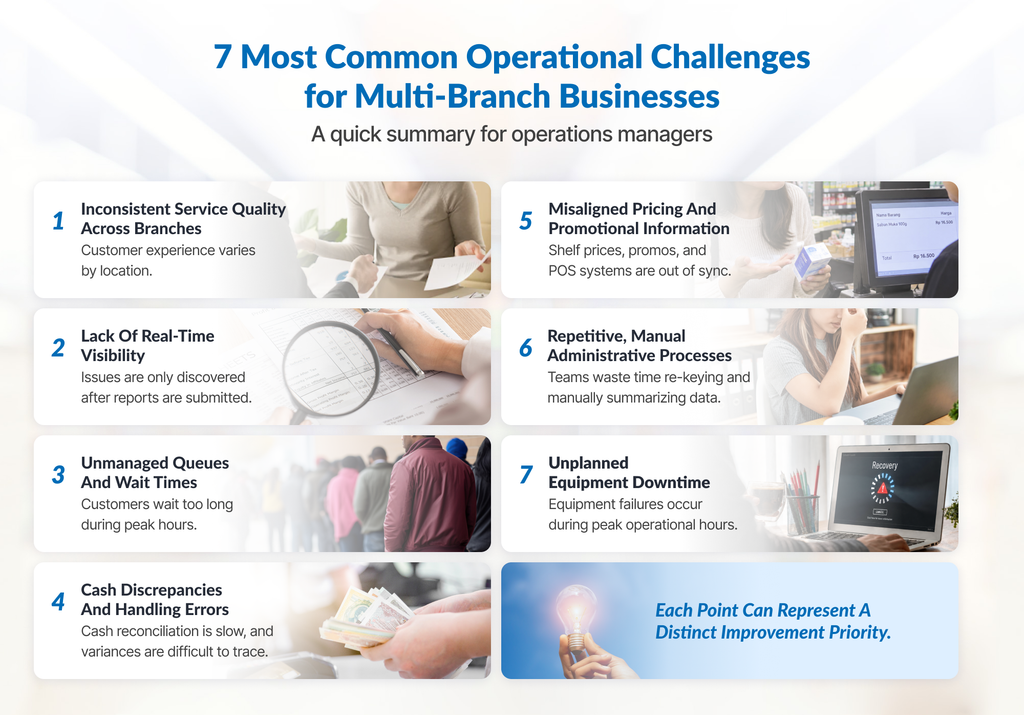
- Inconsistent service quality across different sites depending on frontline branch staff and local leadership.
- Lack of real-time operational visibility due to delayed, manual reports that prevent proactive problem-solving.
- Unmanaged queues and customer wait times during unexpected rush hours that lead to walkaways and lost branch revenue.
- Cash handling discrepancies and errors from manual balancing that create audit gaps, long reconciliations, and staff friction.
- Inconsistent pricing and promotional updates between store shelves and checkouts that frustrate buyers and leak profit margin.
- Repetitive and manual administrative tasks that force branch staff to waste productive hours re-entering duplicate data across siloed tools.
- Unexpected equipment downtime that derails branch throughput without clear repair Service Level Agreements for quick recovery.
1. Inconsistent Service Quality Across Locations
The Symptoms
Customers complain about vastly different experiences depending on which branch they visit. A service that feels seamless at your main city branch feels slow or disorganized at a suburban location, leading to uneven online ratings across your footprint.
The Root Cause
Standard Operating Procedures (SOPs) exist in central documentation folders, but they do not translate into daily frontline behavior. Onboarding relies heavily on local branch managers, leading to regional interpretations of service standards. Without a centralized monitoring system, your standard operating procedures can become inconsistent across branches over time.
The Impact
Inconsistency directly erodes overall brand equity. Modern consumers expect uniform quality regardless of physical location. When service predictability breaks down, opening new locations damages your reputation rather than strengthening your market position.
Strategic Direction
Standardize your service workflows and implement uniform mechanisms to capture customer feedback across all sites. Establishing clear benchmarks ensures operational standards remain constant, regardless of location.
Explore the unified frameworks for optimizing Customer Experience Solutions across your branch network.
2. Lack of Real-Time Operational Visibility
The Symptoms
Headquarters discovers operational failures long after they occur. Issues are typically revealed through monthly financial audits, end-of-week summary reports, or public customer complaints on social media.
The Root Cause
Branch data collection remains manual, fragmented, and delayed. Frontline managers compile performance metrics using separate messaging apps, spreadsheets, and physical logbooks. Compiling this fragmented information into executive summaries takes days or weeks.
The Impact
Leadership constantly manages through the rearview mirror. By the time regional managers spot a performance drop or operational anomaly, the financial loss, customer churn, or operational inefficiency has already impacted the bottom line.
Strategic Direction
Implement automated operational data aggregation that consolidates multi-site metrics into a central real-time dashboard. Centralized reporting provides management with immediate operational visibility, enabling proactive intervention before minor delays escalate into major losses.
Learn how centralized Queue Analytics and Dashboard Systems deliver real-time visibility into operational performance.
3. Unmanaged Queues and Customer Wait Times
The Symptoms
Severe customer congestion occurs unpredictably during peak operating hours. Service counters become overwhelmed, staff stress spikes, and visible lines deter incoming foot traffic, forcing potential buyers to leave without making a purchase.
The Root Cause
Staff scheduling and service point allocations rely on subjective estimates or broad historical averages rather than real-time arrival data. Without granular tracking of wait times and transaction durations, branch leaders cannot align staffing levels with actual customer flow.
The Impact
Unmanaged queues result in hidden revenue leakage. Customers who walk away due to long lines represent lost transactions that never appear in standard point-of-sale accounting, making the true cost of inefficient queuing invisible on basic income statements.
Strategic Direction
Deploy intelligent customer flow management systems that capture foot traffic trends, queue lengths, and service durations by site. Data-driven arrival tracking allows operations managers to optimize roster schedules and dynamic line management based on actual visitor volume.
Discover how smart Queue Management Systems balance customer flow and increase service throughput.
4. Cash Handling Discrepancies and Errors
The Symptoms
Small, routine cash discrepancies occur across multiple register tills. Daily reconciliation takes hours at closing, and tracing the origin of missing funds across multiple shifts and handovers becomes an administrative nightmare.
The Root Cause
Cash handling relies on manual counting at multiple points throughout the business day – from till preparation and shift handovers to daily balancing and safe drops – without automated, continuous audit tracking.
The Impact
Manual counting errors lead to financial losses, delayed bank deposits, and significant administrative overhead. More critically, recurring unaccounted discrepancies create internal distrust and tension between staff and management when accountability cannot be proven.
Strategic Direction
Automate cash processing using equipment that counts, validates, sorts, and logs transactions automatically. This mechanism secures cash instantly while generating a structured, easy-to-track audit trail.
Streamline store operations and eliminate till errors with automated Cash Processing & Management Solutions.
5. Inconsistent Pricing and Promotional Updates
The Symptoms
Promotional campaigns launched by central marketing are applied late at local store shelves, or the price tag listed on the shelf does not match the price scanned at the checkout register.
The Root Cause
Price updates and promotional signage depend on manual execution by branch staff, who must print, locate, and replace physical paper tags across hundreds or thousands of shelf edge locations individually.
The Impact
Pricing mismatches generate immediate customer frustration and erode trust at checkout. Furthermore, delayed price adjustments lead to compliance risks, legal exposure, and margin leakage caused by selling items at outdated lower rates or unauthorized discounts.
Strategic Direction
Adopt centralized digital pricing infrastructure that links central point-of-sale databases directly with automated display updates across all locations simultaneously, guaranteeing complete price integrity across physical and digital touchpoints.
Modernize shelf management and eliminate pricing errors using Electronic Shelf Label Solutions.
6. Repetitive and Manual Administrative Tasks
The Symptoms
Branch staff and supervisors dedicate several hours each day to manual paperwork, re-entering sales figures into spreadsheets, filling out physical compliance checklists, and staying late to complete basic operational recaps.
The Root Cause
Core software applications operate in silos. Because inventory, scheduling, sales, and accounting systems are not directly integrated, administrative workloads increase alongside the risk of employee burnout.
The Impact
High-value human hours are diverted away from direct customer service, sales generation, and team coaching toward repetitive data entry. This increases operational labor costs, elevates human error rates, and accelerates staff burnout.
Strategic Direction
Streamline cross-system workflows by adopting administrative automation tools and establishing software integrations that eliminate duplicate data entry across your physical footprint.
Reduce administrative workloads and improve operational accuracy with the Robotic Process Automation Solutions.
7. Unplanned Downtime and Unclear Resolution Times
The Symptoms
Essential branch hardware – such as POS terminals, cash counters, self-service kiosks, or digital signage – fails during busy trading hours. Branch managers wait days for field technicians to arrive, with no clear timeline for resolution.
The Root Cause
Equipment maintenance is handled reactively rather than preventively. Furthermore, service agreements lack binding, regional-specific Service Level Agreements (SLAs) tailored to multi-site operational demands.
The Impact
Unplanned hardware downtime halts business operations, increases wait times, forces manual workarounds, and directly causes missed revenue for every hour system components remain unresponsive.
Strategic Direction
Shift from reactive repairs to structured, scheduled preventive maintenance programs supported by formal, enforceable SLAs that guarantee fast response times across all geographic branch locations.
Ensure maximum hardware uptime across all your sites with nationwide Maintenance & Support Services.
The Underlying Pattern Behind These Challenges
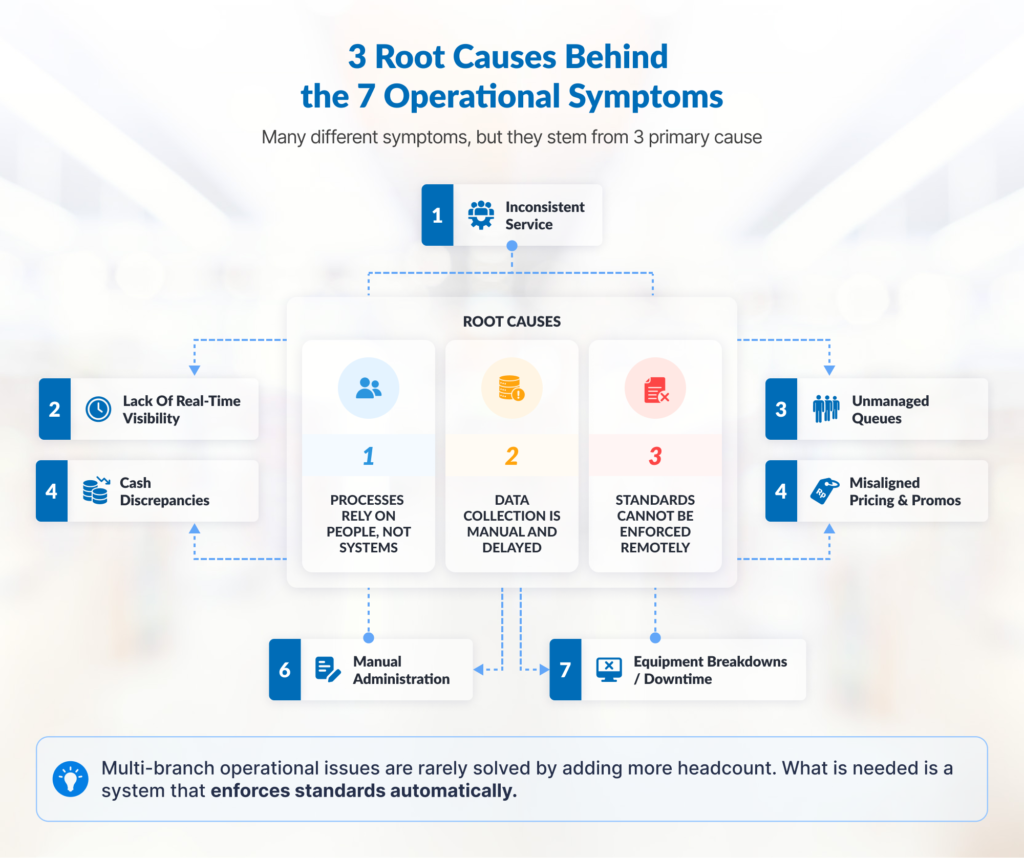
While these seven operational obstacles manifest in different parts of daily branch activities, a closer analysis reveals that they stem from the exact same three core structural gaps:
- Processes rely on individual effort rather than systematic frameworks: When operational quality depends entirely on the memory or discipline of specific staff members, performance fluctuates wildly whenever shift schedules change or employee turnover occurs.
- Data collection is manual, fragmented, and delayed: When operational data is collected manually via spreadsheets or messaging tools, management receives feedback days or weeks after the event. By then, operational issues have already converted into financial losses.
- Standards cannot be enforced remotely without structured tools: As branch networks expand across regions, physical oversight becomes impossible. Without automated guardrails, compliance declines as distance from headquarters increases.
Adding layers of oversight is not always the only answer. In many cases, process improvement, data integration, automation, and centralized visibility can reduce reliance on manual supervision.
Prioritizing Which Operational Issues to Solve First
Attempting to resolve all seven challenges simultaneously can paralyze your organization and overwhelm store teams. To help you prioritize simply, you can use the following scoring framework:
Priority Score = Frequency × Impact × Wasted Time/Cost
Example:
Frequency: 1–5
Customer impact: 1–5
Operational/cost impact: 1–5
Total score: 1–125
Operational Improvement Priority Matrix
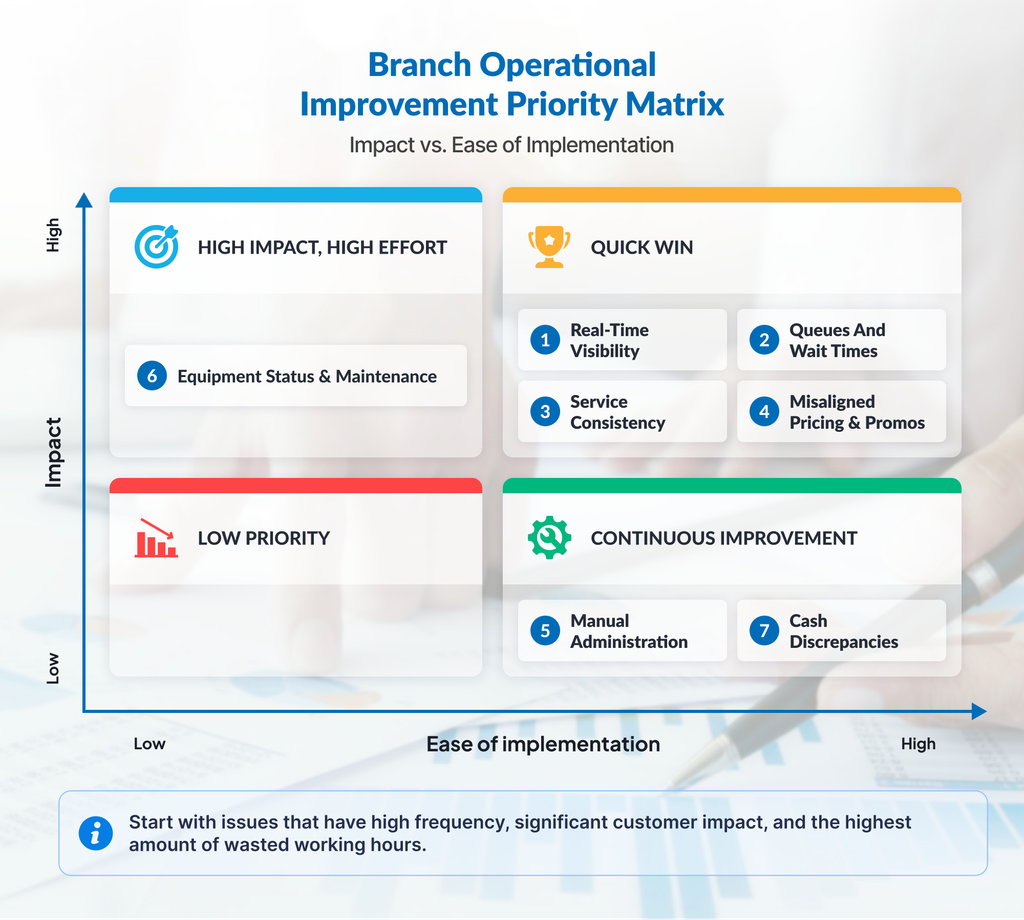
When building your operational roadmap, always begin with Quick Win, the issues that deliver immediate financial recovery or customer satisfaction gains with minimal operational disruption. Tackling one clear bottleneck builds organizational momentum, proves return on investment (ROI), and prepares your team to take on larger strategic initiatives.
Also Read:
- Digital Business Transformation: Where Should Companies Start?
- How to Prioritize Technology Investments on a Limited Budget
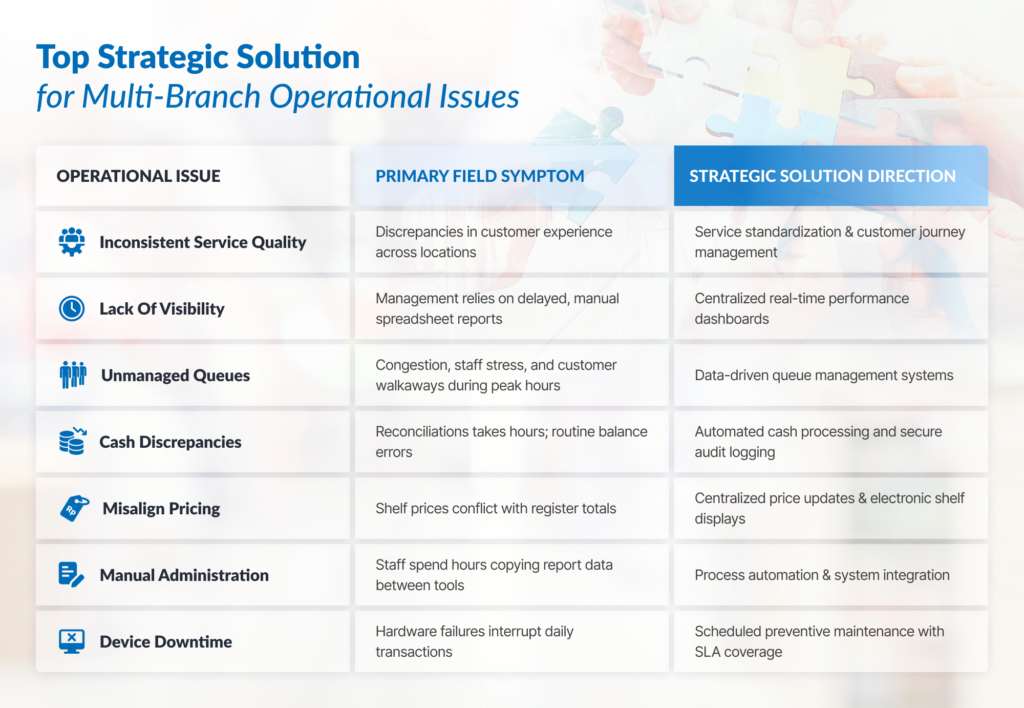
Summary: Operational Challenges vs. Systemic Solutions
Frequently Asked Questions
How many branches can a business manage manually before operations begin to break down?
There is no universal threshold for branch count. The need for a centralized system usually becomes apparent when direct supervision, report consolidation, and cross-location standardization begin to strain head office teams.
Are these operational issues unique to the retail sector?
No. While retail stores frequently struggle with pricing updates and cash handling errors, these exact operational bottlenecks affect healthcare clinics, pharmacy chains, bank branches, F&B franchises, and public service centers alike. Any business model that relies on multi-site physical service delivery faces identical challenges around standardization, visibility, and resource management.
Should we update our SOP documentation or adopt new technology first?
Ideally, business processes and operational targets should be clarified before implementing technology. Digitizing a chaotic workflow only accelerates operational inefficiency—it doesn’t solve it. Define your operational standards and service flows first, then deploy technology built to automate those standards.
How can operations managers monitor distant branches without hiring more supervisors?
Rather than adding costly layers of management, progressive operations teams implement centralized monitoring systems that capture branch data automatically. Real-time dashboards track key metrics and alert regional managers only when performance strays outside pre-set parameters, allowing targeted intervention without constant travel or micromanagement.
Does operational standardization reduce local branch flexibility?
Standardization protects foundational service quality, financial security, and compliance without restricting positive local engagement. Frontline employees remain free to personalize customer interactions and adapt to local market dynamics, while relying on structured back-end systems to execute routine administrative and transactional tasks smoothly.
How long does it take to see measurable results from operational improvements?
The required timeframe depends on problem complexity, number of sites, process maturity, degree of system integration, and deployment scale. Targeted operational improvements typically demonstrate early metrics faster than cross-branch transformations involving legacy or multi-platform systems.
Conclusion
Branch network growth almost always increases operational complexity. The challenge is ensuring that this complexity does not grow faster than the company’s ability to control processes, data, and service standards.
By identifying the most impactful issues, setting priorities, and selecting the right system, companies can expand their network without losing operational visibility and consistency.
Ready to Optimize Your Business Operations?
Explore integrated, ICT-based solutions designed to boost branch efficiency, eliminate queues, and automate enterprise data workflows here.