


Automation vs. Workforce Expansion: How to Determine Operational Investment Priorities


During annual budget planning sessions, business leaders in Indonesia are almost always faced with a tough choice: automation vs. workforce expansion. On one hand, branch managers request additional full-time employees to clear operational backlogs. On the other, the IT team proposes an automated system to solve the exact same issue. With limited budgets, companies can usually approve only one.
Decision-makers often frame this dilemma simply: “Which option is actually better?”
However, the real question isn’t about finding a universally superior path. It is about identifying which solution best aligns with the specific nature of the work being handled.
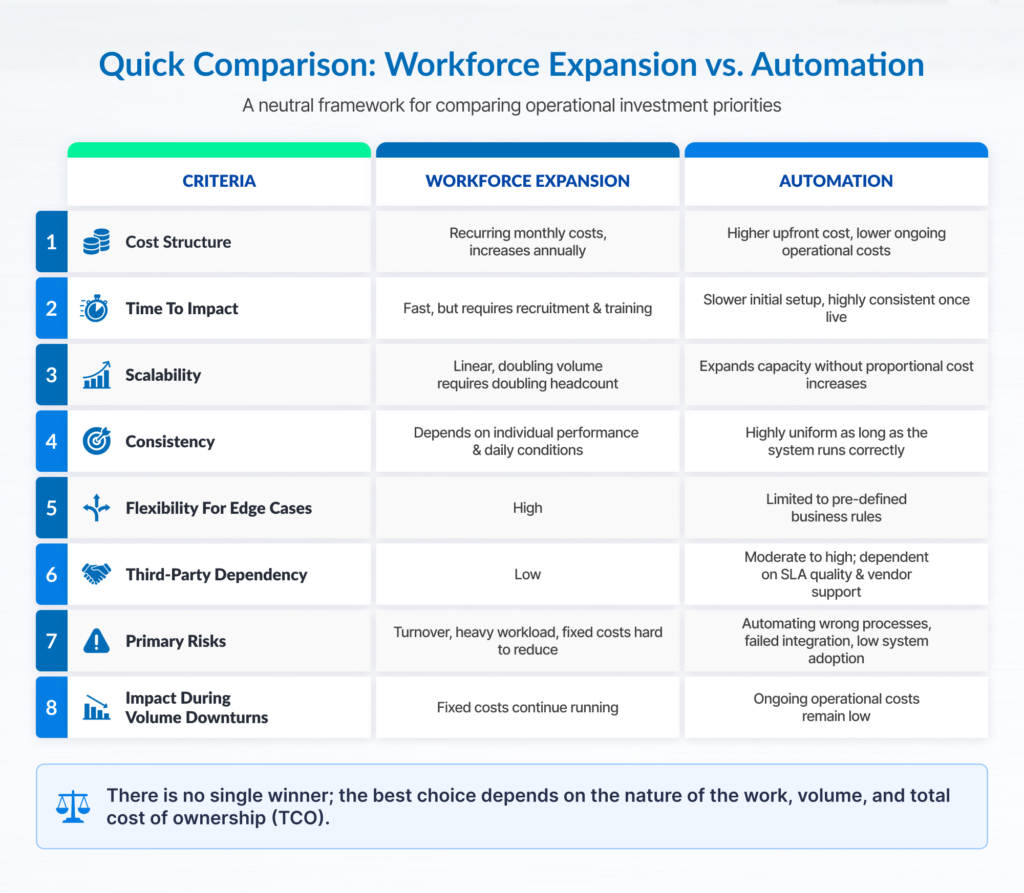
Through this structured framework, you can evaluate both options objectively – from hidden costs to operational risks – ensuring your capital investment yields maximum long-term value.
Why the “Automation vs. Workforce” Debate Is Often Misframed
Treating automation and human labor as direct substitutes frequently leads to misallocated budgets. At their core, these two investments excel in vastly different operational domains.
The fundamental difference lies in how each approach processes work:
- Technology Solutions: Best suited for high-volume, repetitive, and rule-based tasks. Machines process structured data at a constant speed without fatigue.
- Human Labor: Essential for complex, exception-heavy tasks requiring discretion. Strategic negotiations, high-touch client consultations, situational empathy, and unexpected problem-solving rely heavily on human cognitive adaptability.
The most costly operational mistake a business can make is twofold: hiring employees for manual, routine tasks that should be standardized through technology, or implementing rigid systems to handle nuanced processes that require human judgment. Before allocating capital, you must map and categorize the nature of the work first.
At a Glance: Workforce Expansion vs. Automation
The table below summarizes key operational metrics to support your internal evaluation:
| Evaluation Criteria | Workforce Expansion | Implementing Automation |
| Cost Structure | Recurring monthly expense; scales with inflation and salary adjustments. | Higher initial investment (CapEx); lower and more predictable running costs (OpEx). |
| Time-to-Impact | Fast onboarding, but requires ongoing recruitment and training cycles. | Slower initial deployment during integration, but delivers highly consistent output once live. |
| Scalability | Linear; doubling workload volume requires a proportional increase in personnel. | Elastic; easily handles volume surges without proportional cost spikes. |
| Consistency of Output | Variable; dependent on physical condition, fatigue, and individual skill levels. | Highly uniform; consistently executes predefined parameters. |
| Adaptability & Exception Handling | High; humans naturally assess unexpected situations and adapt on the fly. | Low; strictly limited to pre-programmed rules and workflows. |
| Third-Party Dependency | Low; internal management retains direct operational oversight. | High; relies on vendor SLA quality, system updates, and technical support. |
| Primary Operational Risk | High employee turnover, burnout, and fixed costs that are difficult to scale down. | Selecting the wrong process, integration bottlenecks, or underutilized systems. |
| Impact During Downturns | Fixed labor costs persist regardless of declining workloads. | Operational running costs remain relatively low when volumes decrease. |
When Workforce Expansion Is the Right Strategic Move
Expanding your human workforce is not a sign of technological lag. In many operational environments, it remains the most economically rational and strategically sound choice.
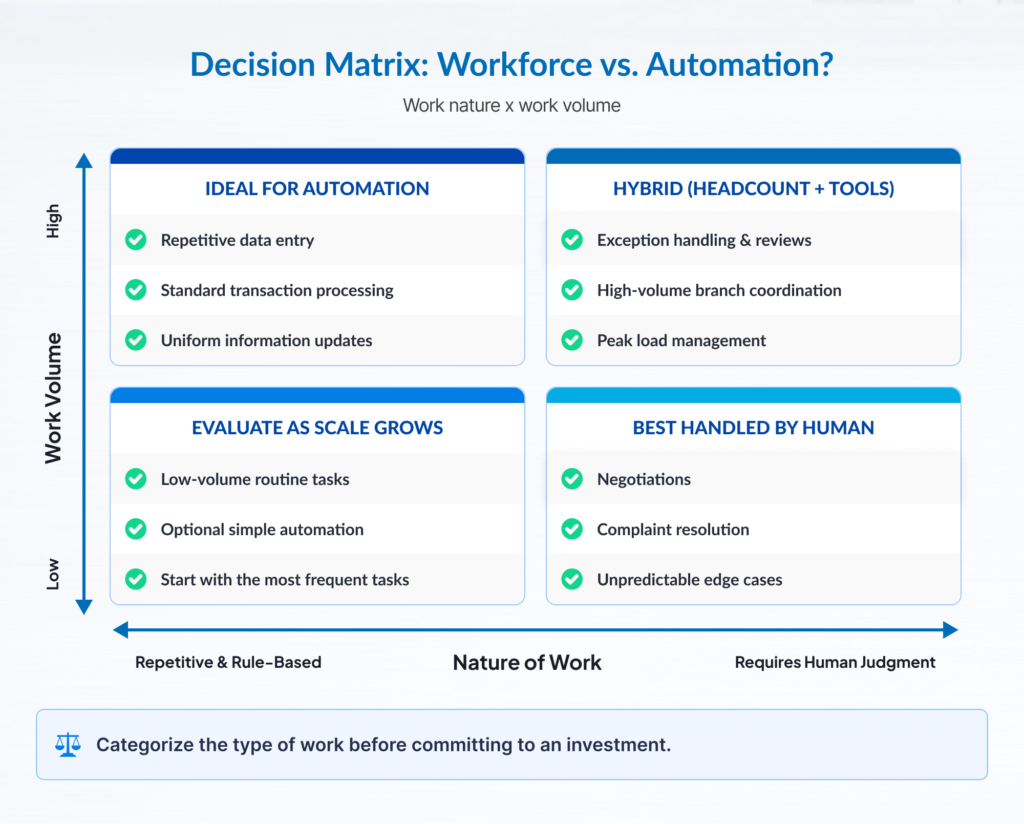
Adding personnel provides a clear advantage in the following scenarios:
1. Work Requires Situational Discretion and Exception Handling
When processes demand context, empathy, negotiation, or ethical judgment, human reasoning is indispensable. Complex corporate loan applications, high-value insurance claims, and advanced customer escalations cannot be reduced to machine logic without compromising service quality.
2. Process Volume Is Volatile or Unstable
If a business unit experiences fluctuating demand without a predictable seasonal pattern, building permanent tech infrastructure risks over-provisioning capacity. Employees offer multifunctional flexibility and can be reassigned when main volumes drop.
3, Business Processes Are Immature or Evolving
Automating unstandardized or frequently changing workflows merely digitizes chaos at a larger scale. If processes shift every few months due to regulatory updates, system re-configuration costs will quickly outweigh the benefits. In an ever-changing workflow, human labor tends to be more flexible compared to systems that require reconfiguration or redevelopment.
4. Human Interaction Is the Primary Value Proposition
In premium hospitality, wealth management, and specialized healthcare, direct human relationships drive customer retention. Forcing digital touchpoints in these environments can erode brand value and alienate clients expecting personalized service.
5. Operational Needs Are Short-Term or Seasonal
For temporary spikes – such as peak retail seasons or administrative campaigns – hiring contract staff avoids long-term capital commitments to hardware or multi-year software licenses.
When Automation Delivers Superior Economic ROI
Conversely, transitioning workflows to automated systems becomes an urgent business imperative when manual processes create bottlenecks that hinder growth.
Deploying technology solutions is economically superior under these conditions:
- High-Volume, Highly Repetitive Data and Material Flows: When business functions involve thousands of identical steps daily – such as manual data entry across systems, bulk cash processing, or queue routing – technology delivers unmatched processing speed and capacity.
- High Financial or Compliance Risks from Human Error: In operations where human oversight causes major losses – such as cash balancing discrepancies in banking, retail pricing errors across hundreds of shelves, or medical record inputs – automated validation minimizes financial leakage and regulatory non-compliance.
- Multi-Branch Operations Requiring Uniform Execution: For enterprise organizations operating across dozens or hundreds of locations, enforcing manual SOP compliance consistently is virtually impossible. Automated systems ensure standardized execution across every branch, unaffected by local staffing variations.
- Skilled Personnel Trapped in Administrative Tasks: When high-value professionals spend significant working hours on repetitive manual data entry, automation frees up their bandwidth to focus on revenue-generating and strategic initiatives.
Uncovering Hidden Costs on Both Sides
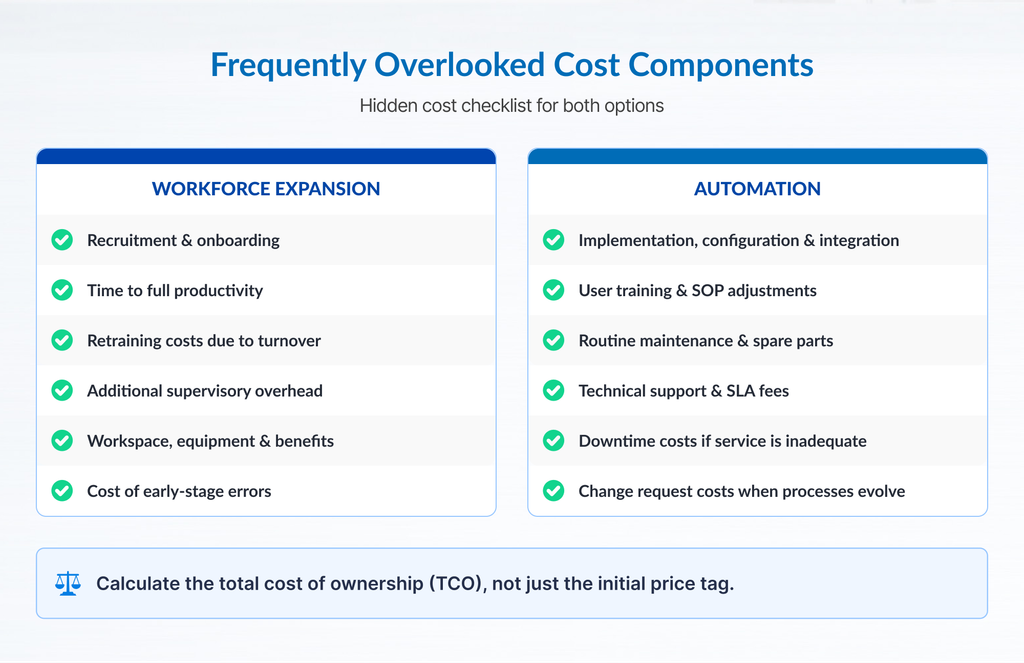
Many operational investments fail to hit their target ROI because decision-makers overlook hidden expenses during initial planning:
Hidden Costs of Workforce Expansion
- Recruitment and Onboarding Overhead: The time and management focus required for sourcing, interviewing, background checks, and formal training before a new hire reaches full productivity.
- Turnover and Retraining Expenses: High employee churn demands continuous spending on re-recruitment and repetitive onboarding cycles.
- Physical and Digital Workspace Overhead: Every new hire requires hardware, software licenses, office space, and administrative support.
- Learning Curve Losses: During the initial onboarding period, new hires still need time to reach full productivity and carry a higher risk of repetitive work.
Hidden Costs of Automation
- System Integration and Configuration: Connecting new software or processing equipment with legacy core infrastructure often incurs additional professional service fees.
- Process Change Management: Updating SOPs, retraining operational supervisors, and driving internal user adoption demand organizational time and energy.
- Maintenance, Spare Parts, and SLAs: Hardware and software require routine maintenance, updates, and ongoing technical support.
- Downtime Risks: When automated systems at branch locations fail, operational halts can disrupt service delivery, diminish operational capacity, and lead to lost revenue.
Uncalculated expense items can quickly strain enterprise budgets. A structured evaluation methodology is essential before committing capital.
How to Calculate It: A 5-Step Framework
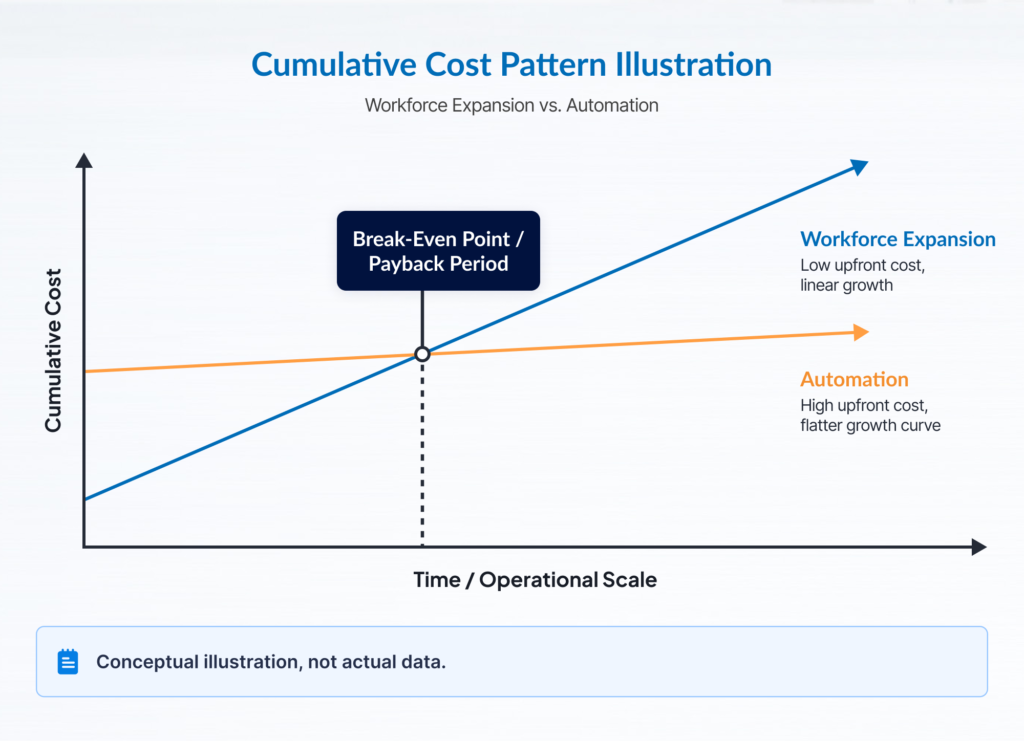
To move beyond intuition or subjective arguments, leverage this 5-step quantitative framework to evaluate your options objectively:
Step 1: Segment Work by Its Underlying Nature
Audit the operational department in question. Divide all daily activities into two categories:
- Rule-based, repetitive, and predictable steps.
- Judgment-based, exception-heavy, and interaction-driven steps.
Calculate the percentage of total operational volume that falls into each category.
Step 2: Measure Precise Baseline Working Hours
Track actual processing times over a two-week period. Document exactly how many labor hours are spent executing manual tasks. Without accurate baseline data, all efficiency projections remain speculative.
Step 3: Calculate Total Cost of Ownership (TCO), Not Purchase Price
- For Workforce: Multiply base salary by a fully loaded factor (typically 1.25x to 1.4x) to account for benefits, healthcare, taxes, workspace facilities, hardware, and training overhead over a multi-year horizon.
- For Technology: Sum the initial system purchase price, implementation fees, user training, and annual maintenance contracts over the estimated asset lifecycle. (Operational Tip: Explore leasing models or managed services to structure capital expenditures into predictable OpEx).
Step 4: Estimate Payback Period Conservatively
Model your finances using cautious assumptions. Overly optimistic scenarios are the primary cause of post-implementation disappointment. Ensure the project still reaches break-even even if deployment is delayed or efficiency gains land below initial targets.
Step 5: Stress-Test Against Volume Growth and Contraction
Project both options across three operational environments:
- Growth (+30% Volume): Does labor cost scale linearly, while technology absorbs the spike with minimal cost increases?
- Stagnation (0% Volume): Does technology maintain a lower fixed cost threshold than recurring payroll?
- Contraction (-20% Volume): Which option offers greater operational flexibility without creating stranded costs?
Choose the option that remains financially resilient across all three scenarios. Furthermore, evaluate vendor capabilities thoroughly. Digital business transformation enablers like PT Murni – backed by over 100 service points across Indonesia and ISO 9001:2015 certified technical support – help mitigate operational downtime through strict, binding SLAs.
Practical Applications Across Operational Functions
Here is how this decision framework applies to real-world business environments:
- Branch Queue & Customer Flow Management: Ticket issuance and initial routing are handled seamlessly via Customer Experience & Self-Service Solutions, leaving branch staff free to handle complex, high-touch inquiries.
- Cash Processing (Banking & Retail): High-volume cash counting, fitness sorting, and serial number recording are offloaded to Cash Processing & Integrated Cash Management Solutions to prevent human error and secure vault operations.
- Multi-Store Retail Price Updates: Updating price tags across thousands of SKUs is centralized in real-time using Electronic Shelf Label (ESL) Solutions, guaranteeing price consistency while freeing floor staff to assist shoppers.
- Cross-System Data Entry: Robotic Process Automation (RPA) Solutions automate data entry across disparate software applications without disrupting existing core system architectures.
- Public Information Display & Wayfinding: Information updates across large facilities are centralized through Digital Signage & Public Information Display Solutions to ensure real-time, uniform communication across all locations.
Common Pitfalls to Avoid
Business leaders frequently fall into these analytical traps during operational reviews:
- Comparing Upfront System Cost Against One Month’s Salary: Juxtaposing initial technology investments against a single employee’s monthly paycheck obscures long-term cost efficiencies realized over several years.
- Ignoring Error Costs and Opportunity Loss: Failing to quantify financial leakage from manual errors or lost business potential while skilled staff perform routine tasks distorts financial analysis.
- Assuming Automation Runs Without Human Oversight: Systems still require supervision, exception handling, and administrative maintenance. Assuming 100% hands-free operation leads to resource miscalculations.
- Automating Unstandardized Processes: Deploying technology onto chaotic workflows only accelerates operational confusion rather than solving it.
- Evaluating Vendors Solely on Hardware Price: Choosing a vendor without assessing SLA commitments, spare part availability, and nationwide field technician coverage risks prolonged system downtime.
FAQ: Automation vs. Workforce Expansion
Does operational automation inevitably lead to layoffs?
Not necessarily. At the enterprise level, technology is typically deployed to absorb routine workloads. This enables existing personnel to be redeployed toward higher-value activities, complex problem-solving, or growth initiatives without increasing overall workforce.
What is the average Return on Investment (ROI) period for automation?
Payback periods vary based on project scope and operational volume. However, enterprise-grade implementations typically reach break-even within 12 to 24 months through reduced administrative hours, error minimization, and expanded throughput.
How should we handle automation if our internal processes change frequently?
Focus on standardizing core processes first before investing in rigid systems. Alternatively, opt for modular, flexible software solutions – such as RPA workflows – that allow easy rule adjustments without revamping your entire system architecture.
Can mid-sized companies with limited budgets benefit from automation?
Yes. Mid-sized enterprises can adopt a phased modular approach or leverage managed services and equipment leasing. This enables access to advanced technology without incurring large upfront capital expenditures (CapEx).
Is it better to purchase hardware outright or lease it via managed services?
Both models offer strategic advantages. Outright purchases minimize long-term operational costs over the asset’s lifespan, whereas leasing converts capital outlay into predictable operational expenses (OpEx) – typically inclusive of technical support and maintenance under a single contract.
What key vendor factors should be evaluated besides equipment price?
Prioritize track record, nationwide service coverage, spare parts availability, technician response times, ISO certifications, and binding Service Level Agreements (SLAs) to guarantee operational continuity.
Driving Data-Driven Operational Priorities
Choosing between automation investments and Workforce Expansion is not about selecting one approach to the complete exclusion of the other. Sustainable operational efficiency stems from a balanced hybrid model: automating high-volume, routine tasks while empowering human talent to focus on complex, high-value endeavors.
When establishing your operational priorities, keep these three principles in mind:
- Categorize Work First: Map workflow characteristics before allocating capital.
- Establish Precise Baselines: Rely on historical data rather than speculative assumptions.
- Calculate Full TCO: Factor in maintenance, technical support, and hidden operational overhead.
As a digital business transformation enabler with over 34 years of experience supporting enterprise clients across 12+ industry sectors in Indonesia, PT Murni Solusindo Nusantara stands ready to help your organization analyze, streamline, and modernize operational workflows with proven technology solutions.
Find the Right Operational Strategy for Your Business
Unsure whether your operational bottlenecks are best solved through workforce expansion or automated systems? Schedule a Free Consultation with PT Murni’s team of experts to receive an objective, data-driven assessment tailored to your business needs.