


Why Does Cheque Processing Take So Long? 5 Key Factors To Know


A cheque has been submitted to the bank, but the customer still needs to wait for the process to be completed and the funds to become available.
Meanwhile, the bank needs to review documents, record and match data, and follow up on the transaction through the appropriate channel. If another bank is involved (an interbank transaction), the process may also follow the applicable clearing schedule.
So, why can cheque processing take longer? This is because each transaction may go through different stages and require different levels of verification.
Therefore, tellers and operations staff need to understand the factors that affect this process so they can explain to customers why each cheque’s processing time is not always the same.
Processing a Cheque is More Than Just Receiving a Document
A cheque is a written instruction from a customer to the bank to pay a specified amount of money to the party named on the cheque.
However, the bank receiving a cheque does not mean that the payment has been completed immediately. Several activities must be carried out before the transaction can be processed further.
In general, the cheque processing workflow includes:
- Document Receipt: The bank receives the cheque from the customer or the party submitting it.
- Document Review: The information and formal requirements of the cheque are reviewed in accordance with the bank’s requirements and procedures.
- Data Entry: Transaction information is recorded for administrative and subsequent processing purposes.
- Data Matching: The information on the cheque is compared with the details required to process the transaction.
- Follow-Up: The transaction is forwarded through the appropriate channel, including additional verification or an interbank process if necessary.
The sequence and implementation of these steps may vary depending on the type of transaction and each bank’s policies.
It is also important to distinguish between the service time at the counter and the transaction completion time. Receiving a cheque may take only a short time, but the process through to payment completion and fund availability can take longer.
Are Same-Bank and Interbank Cheques Processed the Same Way?
Not all cheques go through the same processing path. One determining factor is whether the cheque is deposited at the same bank that is instructed to make the payment, or whether it involves another bank.
An On-Us cheque is a cheque deposited at the same bank as the drawee bank — the bank instructed to make the payment.
Meanwhile, an Off-Us cheque involves two different banks. This interbank transaction may be processed through debit instrument clearing under Indonesia’s National Clearing System (SKNBI), in accordance with the applicable rules and procedures.
Therefore, On-Us cheques do not require interbank clearing, while Off-Us cheques follow a mechanism involving the relevant banks. This difference in processing path also affects the stages and processing time.
5 Factors That Affect Cheque Processing Time
The length of cheque processing is not always caused by a single factor. Several operational activities can affect completion time, including verification, administrative work, confirmation, and waiting time:

1. Document and Information Verification
Once a cheque is received, the bank needs to review the information and formal requirements on the cheque to ensure that it complies with Bank Indonesia requirements and can be processed according to the bank’s procedures.
The information reviewed may include the cheque title, the instruction to pay a specified amount, the name of the drawee bank, the place of payment, the date and place of issuance, and the drawer’s signature.
If any information is unclear or requires confirmation, the bank may need to carry out additional verification. For example, if the writing on the cheque is difficult to read, staff may need to confirm the intended information before proceeding.
2. Data Entry and Matching
The information on the cheque needs to be recorded and matched with the data or documents used in processing the transaction. This step helps ensure that the information passed on to the next stage is consistent with the source document.
In certain workflows, the same data may need to be entered into the system again or recorded at a different stage. If this happens, the administrative workload may increase.
However, repeated data entry does not always occur, as the mechanism depends on each bank’s systems and workflows.
3. Document Transfer and Cross-Department Coordination
Cheque processing may involve several operational departments. Documents or transaction information may need to be passed from one department to another for verification, data entry, or archiving.
If a document is not yet available, the transaction status has not been recorded, or follow-up is still awaiting confirmation, the next task may be delayed. As a result, completion time includes not only the time spent working on the task, but also waiting time.
Processing time refers to the duration needed to carry out activities such as reviewing and recording data. Waiting time occurs when the process cannot continue because it is still waiting for documents, information, or coordination.
This means that a transaction taking longer does not indicate that staff are working slowly. Part of the time may be spent on handovers and coordination between departments.
4. Interbank Cheques Follow Clearing Schedules
Off-Us cheques involve an interbank process that may require debit instrument clearing through SKNBI. This process follows the applicable service mechanisms and schedules.
Therefore, the time a cheque is submitted does not always coincide with the clearing execution time. Transaction cut-off times and operational requirements can also affect when the cheque can be processed.
It is important to note that the debit instrument clearing schedule is different from the fund transfer schedule through SKNBI and BI-FAST, as each service has a different operating mechanism.
5. Data Discrepancies That Require Follow-Up
During the verification stage, the bank may find information that is unclear, inconsistent, or requires further confirmation. This may require document retrieval, additional verification, or coordination with the relevant parties.
For example, the characters printed on a cheque may be difficult to read, so they need to be reviewed again.
However, difficulty reading data does not automatically mean that the cheque will be rejected or that the payment will fail. The decision and follow-up still depend on the verification results and the bank’s policies.
Required Verification Time vs. Rework
Not every activity that takes time can or should be eliminated to make cheque processing appear faster. For example, document verification and information matching are part of the necessary controls in cheque processing.
To evaluate workflows, banks need to distinguish between activities that are genuinely required and additional work that could potentially be reduced.
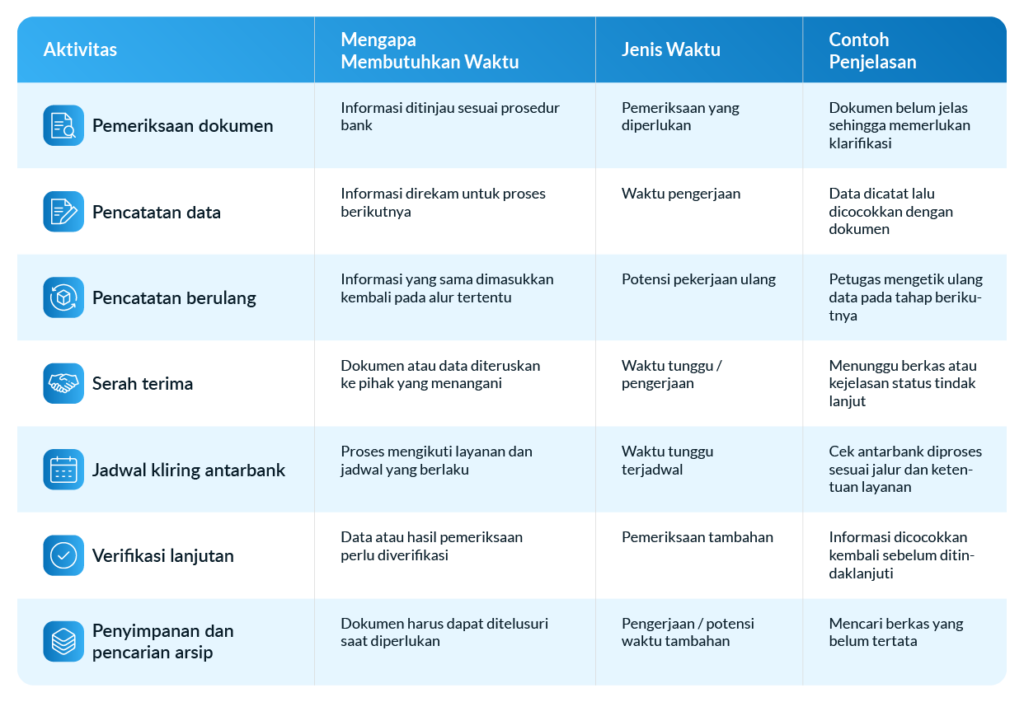
The table above is an illustration to help understand the types of activities and time involved in cheque processing; it is not an audit result or a description of every bank’s SOP.
Process improvements should focus on repetitive tasks, document retrieval, and unstructured coordination. Meanwhile, necessary verification and controls must still be carried out.
What Banks Can Do to Make Cheque Processing More Organized
Banks can evaluate several operational aspects to help the process run more smoothly without reducing the accuracy of verification.
- Document Completeness and Legibility: Ensure that the information on the cheque is legible and can be reviewed according to applicable procedures.
- Data Entry Accuracy: Match recorded data with the source documents to reduce the risk of discrepancies.
- Clear Handovers: Ensure that document transfers and follow-up responsibilities are properly recorded.
- Transaction Status Monitoring: Track the progress of each process so that relevant departments know which tasks have and have not been completed.
- Records Management: Store documents systematically so they can be easily retrieved when needed.
To support these activities, technology can help read characters on cheques, scan documents, and make digital archives easier to search. One of the technologies used in cheque processing is MICR (Magnetic Ink Character Recognition).
This technology reads characters printed with magnetic ink on certain parts of the cheque. The results can support data entry and processing, but they do not replace transaction verification and review.
FAQ: Common Questions About Cheque Processing Time
Here are some frequently asked questions about how long cheque processing takes:
1. Do all cheques have to go through interbank clearing?
No. On-Us cheques are processed within the same bank, so they do not require interbank clearing. Meanwhile, Off-Us cheques involve different banks and may go through debit instrument clearing in accordance with applicable regulations.
2. Does a manual cheque process always take longer?
Not necessarily. Processing time depends on transaction volume, workflow, verification requirements, and the systems used by the bank. Manual processes may add data entry or document retrieval work, but they do not automatically make every transaction slower.
3. Does receiving a cheque mean the funds are immediately available?
Receiving a cheque is only the beginning of the process; it does not guarantee that the payment has been completed or that the funds are available. Availability depends on the transaction channel, verification results, and the bank’s policies.
Understanding Cheque Processing to Support Bank Operations
Cheque processing time is influenced by document verification, data entry, cross-department coordination, clearing schedules, and follow-up when discrepancies are found. By understanding these factors, staff can explain the process to customers while also identifying opportunities to improve operational efficiency.
To support this process, PT Murni Solusindo Nusantara provides cheque processing and archiving solutions that include MICR reading, document scanning, and digital archive search.
With experience in developing cheque processing systems for commercial banks and a nationally scaled Clearing Facility Center, PT Murni helps banks manage cheque documents and information so they are easier to access and trace.
Want to know what happens after a cheque is submitted to the bank? Read the article ‘The Bank Cheque Processing Workflow: From Receipt to Payment’ to understand the cheque processing stages in more detail.