As the Internet of Things (IoT) matures, smart retail technologies are playing a pivotal role in transforming brick-and-mortar operations, inventory management, and the overall customer experience. In recent years, the physical store environment has undergone a subtle yet profound evolution: paper price tags are giving way to digital displays, scales automatically issue barcodes, interactive screens engage shoppers, and traditional checkout counters are no longer the sole transaction point.
This shift extends far beyond aesthetics. By automating labor-intensive, repetitive manual tasks, these technologies allow store staff to focus on customer service and high-value operations. For retail enterprises, strategic deployment of smart retail solutions optimizes operational efficiency, protects profit margins, and delivers an elevated shopping experience.
This comprehensive guide provides an end-to-end roadmap of the modern retail technology landscape, detailing core functions, operational advantages, and implementation strategies tailored to various store scales.
Dive Deeper to The Concept of Smart Retail
Smart retail integrates data-driven systems and IoT hardware to automate store operations, heighten inventory accuracy, and enhance in-store customer engagement. This transformation relies on three operational pillars:omnichannel data accuracy, peak-hour throughput, and multi-store consistency.
At its core, smart retail is not merely a collection of standalone gadgets; it relies on seamless, real-time connectivity across core enterprise systems, including Point of Sale (POS) platforms, inventory databases, and shelf-edge displays.
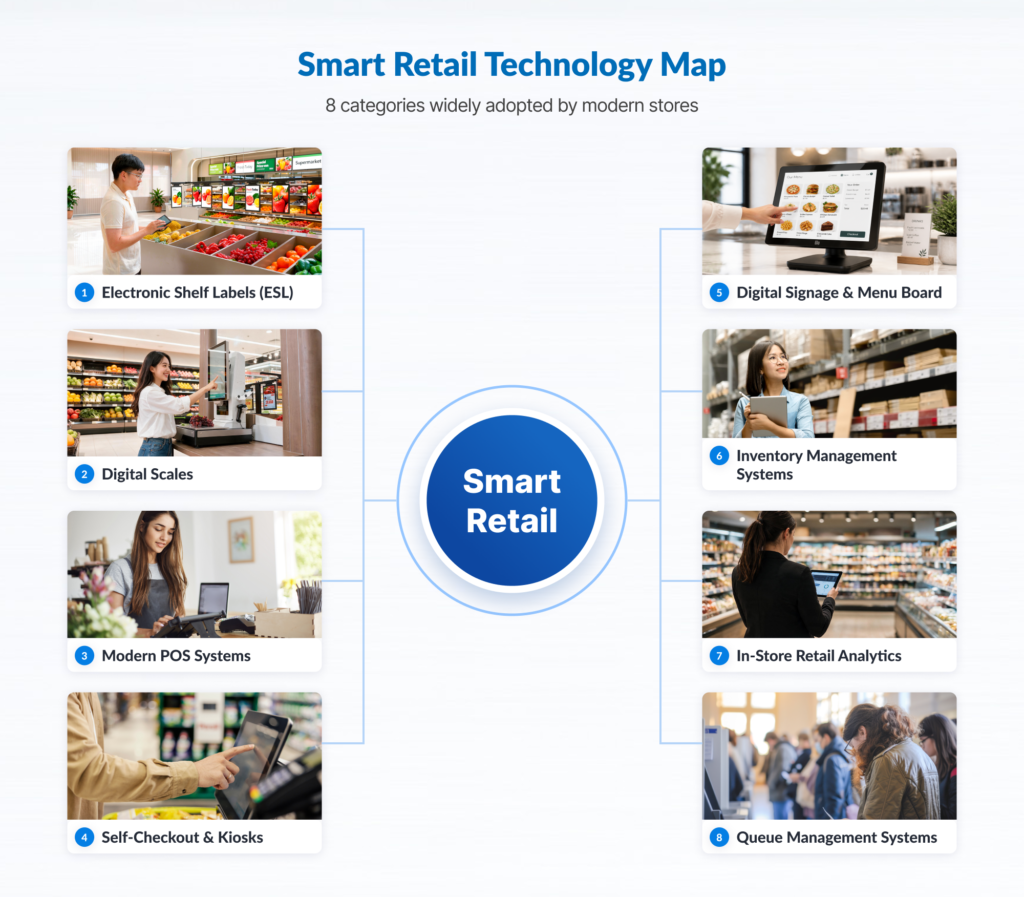
Within the modern retail technology ecosystem, store operations generally encompass eight core categories:
- Electronic Shelf Labels (ESL) automate shelf pricing updates and eliminate pricing discrepancies.
- Digital Scales & Automated Labeling expedite product weighing and automated barcode generation.
- Modern POS & Extended Transaction Points synchronize transactions, payments, and stock levels in real time.
- Self-Checkout & Self-Service Kiosks provide self-service alternatives while reducing front-end queuing.
- Digital Signage & Menu Boards enable centralized management of promotional content and dynamic display updates.
- Inventory Management & Traceability deliver real-time stock visibility to prevent stockouts.
- Store Analytics & Footfall Monitoring capture customer flow data to optimize labor scheduling and store layout.
- Queue Management Systems regulate customer flow to decrease perceived and actual wait times.
Smart Retail Technologies and Core Functions
Electronic Shelf Labels (ESL)
Electronic Shelf Labels utilize low-power e-paper displays mounted on shelf rails to show pricing, product specifications, and promotional messages. Connected wirelessly to a central server, price updates made in the core database reflect instantaneously across thousands of shelf tags without manual intervention.
- Core Pain Point Addressed: Eliminates manual paper re-labeling across thousands of SKUs, which is prone to human error. Therefore preventing price mismatches between shelf and checkout that undermine customer trust.
- Target Environment: Supermarkets, hypermarkets, consumer electronics stores, pharmacies, and hardware chains with high SKU counts, frequent price adjustments, or dynamic pricing strategies.
- Deployment Prerequisites: Enterprise integration between central inventory/POS databases and a robust wireless gateway infrastructure throughout the retail floor.
Digital Scales and Automated Labeling
Modern commercial digital scales integrate heavy-duty weighing mechanisms, real-time price calculation driven by master databases, and high-speed thermal barcode printing into a single workflow for fresh food and bulk sections.
- Core Pain Point Addressed: Mitigates bottlenecks in fresh produce, meat, deli, and bakery sections while eliminating manual price calculation errors. Standardized barcode output ensures frictionless checkout scanning.
- Target Environment: Grocery stores, supermarkets, specialty food retailers, and bulk goods stores managing variable-weight inventory.
- Deployment Prerequisites: A clean, structured master product database featuring standardized Price Look-Up (PLU) codes synchronized across all weighing hardware.
Modern POS and Extended Transaction Points
Next-generation Point of Sale (POS) systems serve as the transactional engine of the store, connecting fixed registers, mobile tablets, and handheld devices directly to cloud-based or on-premises inventory control and financial reporting modules.
- Core Pain Point Addressed: Resolves front-end congestion during peak hours and eliminates delayed sales reporting. Management gains real-time visibility into stock movement and revenue without waiting for end-of-day register reconciliation.
- Target Environment: All retail formats, ranging from single boutique stores to multi-regional retail chains requiring real-time operational control.
- Deployment Prerequisites: Stable internet connectivity, secure local networking, and peripheral hardware compatibility with modern payment standards (including credit cards, contactless payments, and QR code standards).
Self-Checkout and Self-Service Kiosks
Self-checkout lanes and self-ordering kiosks utilize interactive touchscreens, embedded barcode scanners, and integrated payment terminals to enable fully autonomous scanning, ordering, and payment.
- Core Pain Point Addressed: Alleviates register lines during peak traffic and allows operators to reallocate staff from manual scanning to customer assistance, shelf replenishment, and store maintenance.
- Target Environment: Urban convenience stores, quick-service food outlets, fast-casual dining, high-volume pharmacies, and transit-hub retail units.
- Deployment Prerequisites: An intuitive, user-friendly UI/UX, stable payment gateway integrations, optimal floor layout design, and initial on-site staff facilitation for customer onboarding.
Digital Signage and Digital Menu Boards
Digital signage system utilizes commercial-grade visual displays managed via a centralized Content Management System (CMS). This system allows retailers to deploy dynamic promotional campaigns, high-definition promotional videos, and real-time menu updates across individual stores or nationwide networks.
- Core Pain Point Addressed: Eliminates recurring design, printing, and distribution costs associated with static paper marketing materials, while preventing campaign execution delays by ensuring synchronized go-to-market messaging across all locations.
- Target Environment: Quick-service restaurant (QSR) chains, fashion boutiques, cosmetics retailers, lifestyle stores, and multi-location retail brands running frequent seasonal promotions.
- Deployment Prerequisites: High-quality visual media production, licensed CMS software, commercial displays, and sufficient network bandwidth for remote content distribution.
Inventory Management and Stock Traceability
Advanced inventory management systems combine rapid barcode scanning, enterprise mobile computers, and RFID technology to track inventory movement accurately from distribution centers to the backroom and sales floor.
- Core Pain Point Addressed: Resolves inventory discrepancies, prevents lost revenue caused by stockouts, and minimizes working capital tied up in slow-moving inventory.
- Target Environment: Value scales alongside store count, warehouse complexity, and SKU variance, making this critical for mid-to-large-scale retail operations.
- Deployment Prerequisites: Strict operational discipline regarding scanning protocols during receiving, stock transfers, and shelf replenishment, backed by reliable ERP or WMS integration.
Store Analytics and Customer Traffic Monitoring
Retail analytics platforms utilize specialized traffic-counting sensors, optical cameras, and Wi-Fi signal tracking to collect quantitative data on shopper traffic patterns, dwell times, and queue lengths.
- Core Pain Point Addressed: Replaces guesswork with empirical data. Store managers can optimize labor scheduling against footfall peaks, measure display conversion efficiency, and refine floor plan layouts.
- Target Environment: Mid-to-large retail formats, department stores, flagship locations, and shopping mall units with high daily traffic.
- Deployment Prerequisites: Well-defined analytical targets and Key Performance Indicators (KPIs) to transform raw traffic data into actionable operational improvements.
Queue and Customer Flow Management Systems
Digital queue management solutions organize customer waiting lines using automated ticket dispensers, directional digital displays, and audio announcements, particularly for service counters requiring consultation or customization.
- Core Pain Point Addressed: Eliminates disorderly physical lines, minimizes perceived wait times, reduces shopper friction, and provides management with metrics on service speed per counter.
- Target Environment: Retail formats featuring specialized service counters, including prescription pharmacies, telecom service centers, optical shops, and customer service desks.
- Deployment Prerequisites: Clear counter segmentation, comfortable waiting areas, and prominent display screens visible across the waiting floor.
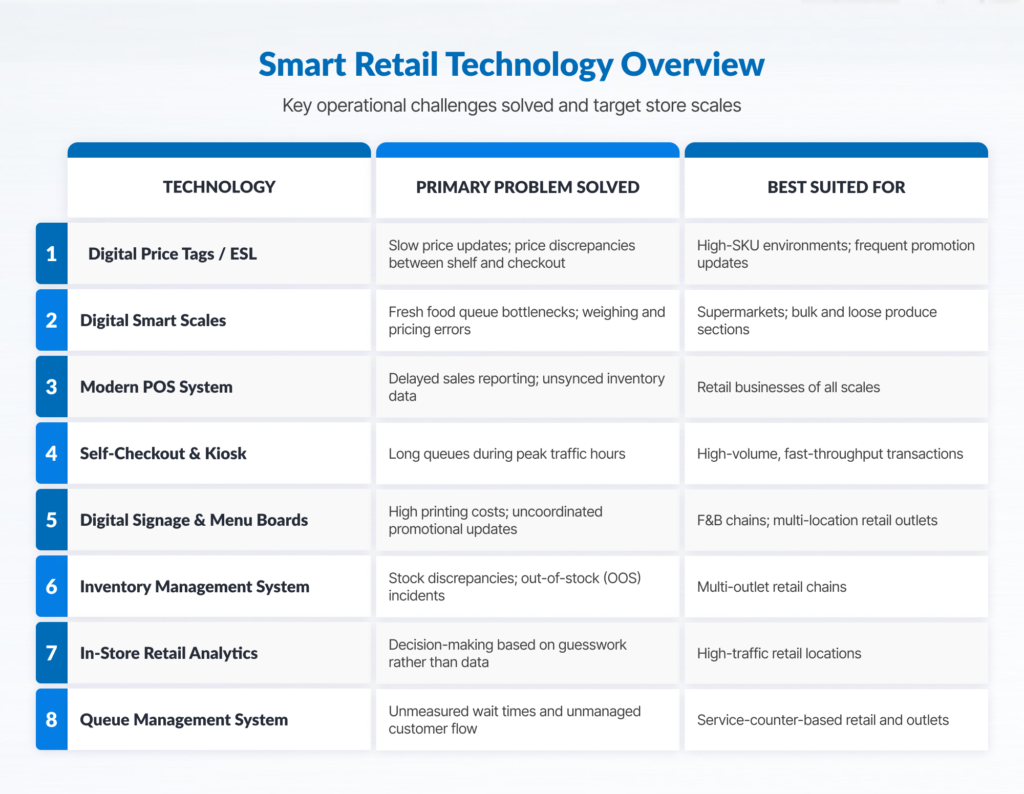
Summary Matrix: The Modern Retail Technology Landscape
System Integration: The Core Driver of Smart Retail ROI
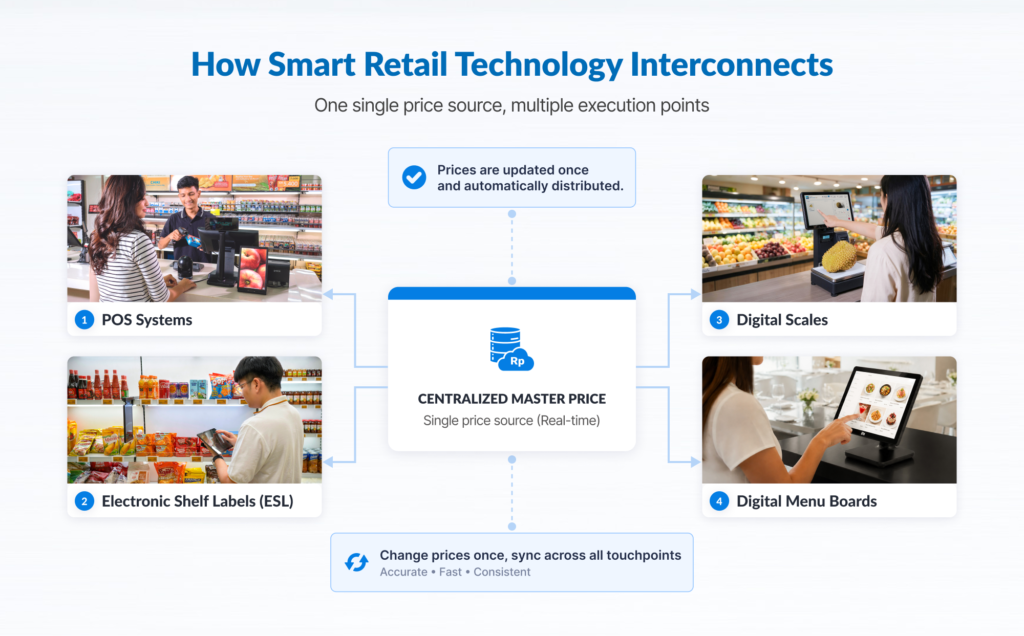
The primary value of retail digitization lies not in deploying standalone hardware, but in establishing real-time interoperability across devices. Maximum ROI is achieved when peripheral hardware seamlessly exchanges data with backend enterprise systems.
With proper integration, a price adjustment executed in the central database propagates automatically to the POS, Electronic Shelf Labels, digital scales, and customer-facing digital signage simultaneously.
Ultimately, long-term success in smart retail depends on system interoperability rather than sheer hardware volume.
Selecting the Right Technology Roadmap
Retailers don’t and should not need to deploy all technologies simultaneously. Over-implementing complex systems without a solid foundation can disrupt daily operations. Scale technology adoption based on store count and operational complexity:
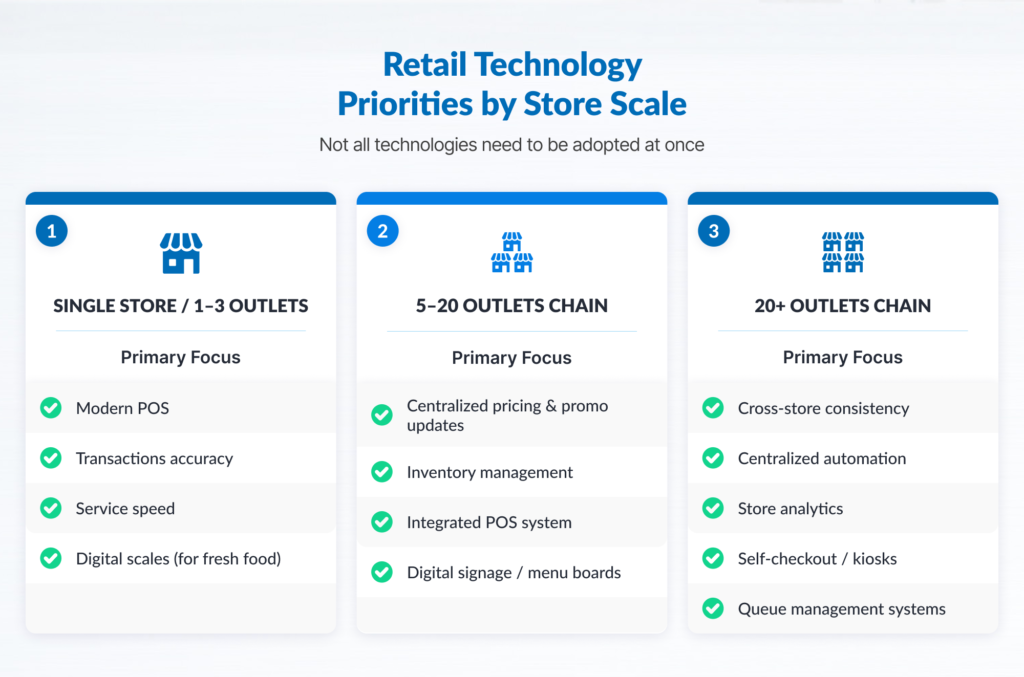
1. Emerging Chains (1 to 3 Locations)
At this scale, centralized infrastructure management offers limited return. Capital expenditure should focus on tools that resolve immediate operational bottlenecks, accelerate checkout speed, and secure cash control:
- Cloud-based modern POS supporting multi-payment options.
- Integrated digital scales (essential for fresh produce or bulk formats).
- Basic barcode scanning and stock-logging tools to mitigate shrinkage.
2. Growing Networks (5 to 20 Locations)
As the store footprint expands, manual price updates, localized promotional rollouts, and decentralized stock allocations become major operational drags:
- Electronic Shelf Labels (ESL) to eliminate shelf-to-register pricing discrepancies across branches.
- Centralized digital signage to maintain brand consistency while cutting print overhead.
- Multi-location inventory management systems to streamline inter-store transfers and warehouse fulfillment.
3. Enterprise Retail Networks (20+ Locations)
For large-scale retail chains, labor optimization and operational consistency drive competitive advantage. Automation transitions from an operational preference to a core necessity:
- Full-scale ESL deployment integrated with automated planogram compliance monitoring.
- Self-checkout lanes and self-service kiosks to manage high transaction volumes efficiently.
- Advanced store analytics (footfall counters and queue monitoring) to optimize labor allocation and maximize revenue per square meter.
A common industry pitfall is investing prematurely in complex peripheral systems before establishing clean master data. Always map operational bottlenecks prior to committing hardware capital.
Implementation Prerequisites for Smart Retail Deployments
Deploying digital solutions in physical stores is an operational transformation project rather than a routine IT procurement task. To ensure seamless execution and user adoption, build upon the following operational foundations:
- Master Data Audit & Fixing: Electronic shelf labels, scales, kiosks, and POS systems rely entirely on data integrity. Standardize product names, SKUs, PLUs, price structures, and tax categories prior to system integration.
- Standard Operating Procedure (SOP) Alignment: Technology accelerates well-defined processes, but amplifies operational disorder if workflows are unstructured. Document receiving, price override, return, and shelf-replenishment workflows before applying automation.
- API and System Compatibility: Legacy POS or ERP systems must support seamless integration (via REST APIs or enterprise data connectors) to communicate with new hardware without requiring costly custom middleware.
- Network Infrastructure & Power Stability: Wireless devices (including ESLs and mobile POS units) demand stable local connectivity. Conduct thorough site surveys for Wi-Fi and gateway coverage, and ensure hardware is backed by surge protection.
- Comprehensive Workforce Training: Store personnel must be proficient in operating new equipment, troubleshooting basic technical issues, and guiding first-time customers through self-service interfaces.
- Nationwide Technical Support & Service Level Agreements (SLAs): Retail hardware undergoes continuous operational strain. Partner with technology vendors offering nationwide field coverage and binding SLA commitments to ensure business continuity.
Smart Retail Adoption Trends
Many forward-thinking retailers adopt a phased implementation methodology: resolving immediate front-end friction before scaling capital expenditure into advanced automation.
Key market drivers accelerating this transition include:
- Digital Payment Ubiquity: The rapid growth of digital wallets and unified QR payments has normalized fast, contactless checkout, creating ideal conditions for self-service kiosks and modern POS systems.
- Rising Operational and Labor Costs: Margin pressure encourages retailers to automate manual tasks, such as re-tagging shelves and physical stock audits, allowing labor to be redirected toward high-touch customer service.
- Omnichannel Consumer Expectations: Modern shoppers expect physical stores to offer the speed, pricing accuracy, and inventory visibility typical of e-commerce platforms.
Rather than attempting full store automation overnight, a modular approach empowers businesses to resolve their most pressing operational pain points first.
Frequently Asked Questions (FAQ)
Is smart retail technology only suitable for enterprise chains?
No. Single-store operators capture immediate value from foundational tools. Modern POS platforms and integrated digital scales significantly improve data accuracy and financial reconciliation regardless of scale.
Which technology should be implemented first?
Begin with a modern POS system and centralized inventory management. A structured master data architecture and robust POS ecosystem are essential prerequisites before introducing peripheral hardware like self-checkout kiosks or digital shelf labels.
Do all smart retail devices require uninterrupted internet connectivity?
Offline resilience depends on system architecture. Many enterprise POS systems and smart hardware support local offline modes, allowing continuous core processing over local networks before auto-synchronizing once connectivity is restored.
Does adopting smart retail require replacing legacy POS hardware?
Not necessarily. Most modern hardware peripherals can interface with legacy POS or ERP platforms via APIs or enterprise middleware, provided the existing backend supports structured data export.
What is the typical deployment timeline?
Timelines range from a few days for single-site hardware deployments to several months for phased multi-store rollouts requiring enterprise integration, network configuration, testing, and change management.
Will smart store technologies replace retail employees?
No. Smart retail technologies automate repetitive, low-value tasks (such as manual price updates and product weighing) reallocating staff toward customer engagement, sales assistance, and store presentation.
The Future of Physical Retail Starts at Every Integration Point
Modernizing physical retail is not a matter of acquiring hardware, it is about engineering an integrated ecosystem tailored to clear operational objectives. Long-term success relies on executing the correct deployment sequence, ensuring seamless system integration, and partnering with reliable technical support. A flexible digital foundation ensures your retail network remains operationally resilient and competitive.
Explore smart retail solutions for your enterprise here. From Electronic Shelf Labels and modern POS systems to self-service kiosks and digital signage, discover scalable technology solutions designed for your operational needs.