


5 Main Causes of Price Discrepancies Between Shelves and Cash Registers in Retail Stores


Price discrepancies between shelf labels and cash registers remain one of the most persistent operational challenges in the retail industry, especially across multi-branch chains.
Consider a scene familiar to every store manager: a customer arrives at the checkout counter, only to discover that the price scan on the register screen is higher than the tag on the shelf. The cashier checks the system, only to find that the price on the POS does not match the one displayed on the shelf. This issue goes far beyond customer inconvenience. Price discrepancies can also slow down checkout lines, cause purchase cancellations, reduce potential sales, and, over time, erode customer trust in the brand.
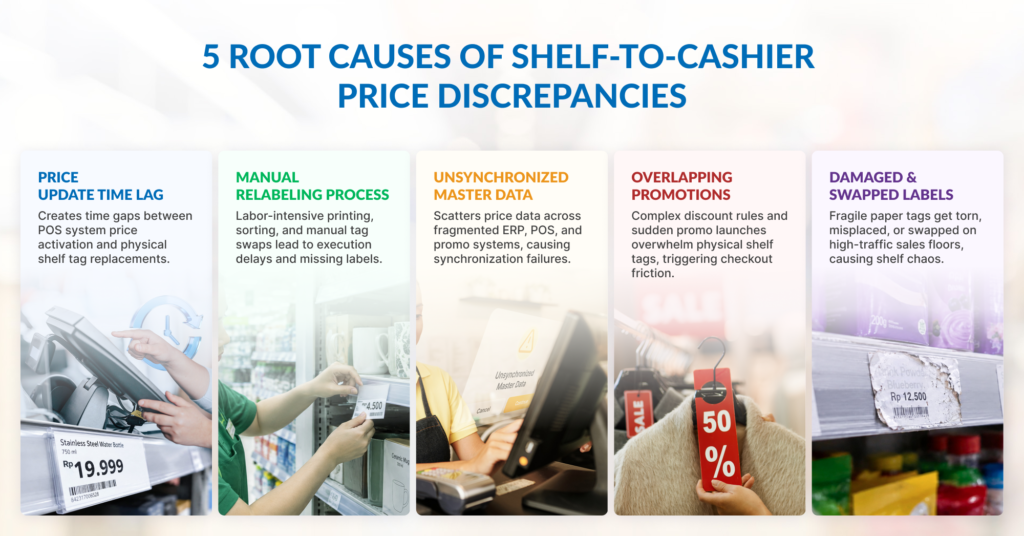
Crucially, these price mismatches rarely result from staff negligence. Instead, they stem from inherent time lags in price updates, manual processes, and unsynchronized systems.
Here are the 5 main causes of price discrepancies in retail stores:
- Time lag between system price updates and physical shelf label replacement.
- Manual label replacement processes prone to human oversight.
- Unsynchronized price master data across systems and store locations.
- Overlapping promotional programs and complex pricing rules.
- Damaged, misplaced, or swapped shelf labels.
Read on to explore why each of these issues occurs and how to address them at the root cause.
1. Time Lag Between System Price Updates and Physical Shelf Label Replacement
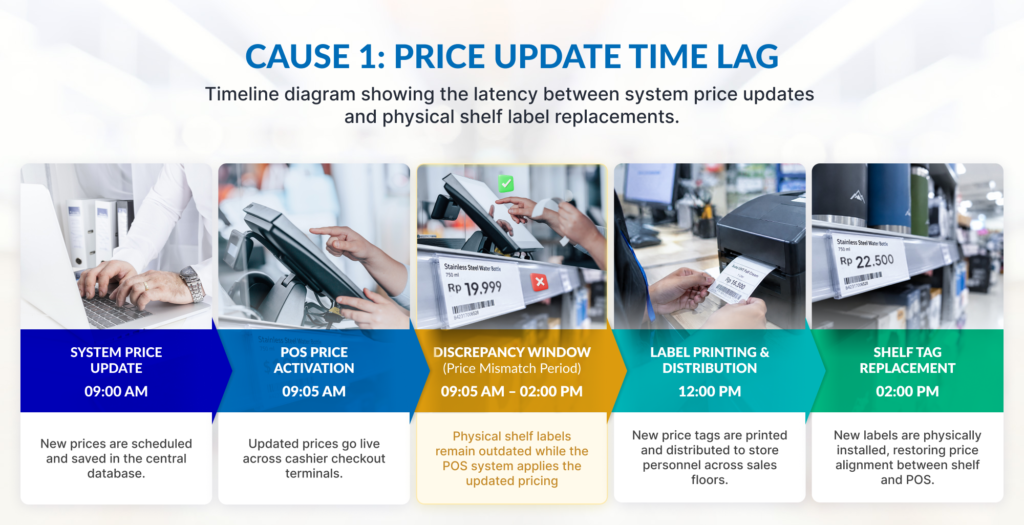
How It Happens
Price changes are usually scheduled in the central database to take effect at a specific time, such as midnight (00:00 AM). However, store staff can only physically replace the shelf labels once their shift begins the following morning. During this interval, the POS system charges the new price while the shelf displays the old one.
Why It Is Hard to Avoid
As a store expands its Stock Keeping Unit (SKU) catalog and increases promotional frequency, the window of discrepancy grows wider. Replacing hundreds of paper tags across multiple aisles requires hours of manual labor that cannot happen instantaneously.
Visible Symptoms
Timing delays trigger heavy checkout friction during opening hours. Price mismatches spike as early morning shoppers pick up items before staff finish replacing shelf tags. This creates immediate customer disputes on campaign launch days, especially for fast-moving items and daily promotional deals.
Aggravating Factors
Last-minute flash sales and sudden promo changes worsen this operational delay. Without advance warning from central teams, store associates are forced into rushed, reactive relabeling on an active sales floor, directly leading to price disputes at the register.
2. Manual Label Replacement Processes Prone to Human Oversight
How It Happens
Store staff print batches of price change lists and walk the floor to swap paper tags individually. Labels are easily missed when an item is temporarily out of stock, hidden behind merchandising displays, or when price update lists are too long to complete in a single shift.
Why It Is Not the Staff’s Fault
Manual relabeling is a high-volume task executed on the floor while staff actively assist shoppers. Without an automated verification mechanism, missing a label among thousands of SKUs is a natural outcome of process design, not a lack of effort.
Visible Symptoms
These issues usually show up as unpredictable price errors across unrelated aisles, rather than following a clean pattern. Often, it’s shoppers who catch these mismatches at checkout instead of store audits, creating friction right at the register.
Aggravating Factors
Manual relabeling errors surge under operational pressure. High employee turnover, frequent shift rotations, and constant customer interruptions make missed aisles and misplaced price tags almost inevitable.
3. Unsynchronized Price Master Data Across Systems and Store Locations
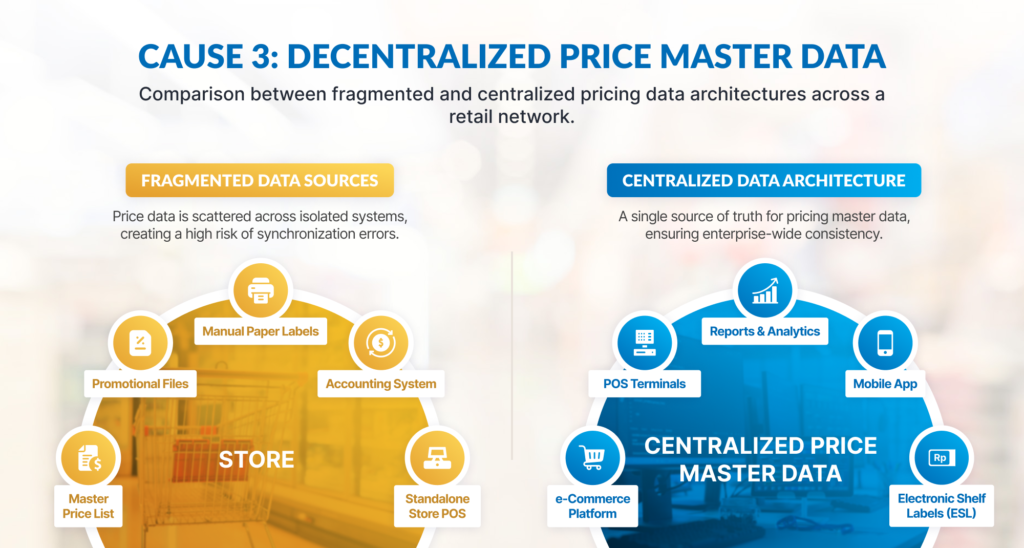
How It Happens
Retailers often manage pricing across disconnected platforms: enterprise resource planning (ERP) databases, local POS databases, and separate promotional files. When these platforms fail to sync properly, the register pulls data from one source while the printed label reflects another.
Why It Is Hard to Avoid
Keeping pricing synchronized across multiple store locations is a constant challenge. Complex regional pricing, local inventory markdowns, and store-specific loyalty deals create endless opportunities for errors. Worse, temporary network drops or cloud outages at local branches can silently block price updates from applying, leaving store teams unaware that their tags are displaying outdated prices.
Visible Symptoms
Data synchronization failures typically manifest as localized anomalies rather than chain-wide outages. Pricing discrepancies often cluster within specific branches or isolate particular vendor lines due to failed database batch updates.
Aggravating Factors
The real danger of unsynchronized master data is its hidden nature. Because these errors stem from deep back-office database pipelines, floor staff have no way of knowing a shelf tag is wrong until checkout.
4. Overlapping Promotional Programs and Complex Pricing Rules
How It Happens
A single SKU may qualify for multiple simultaneous campaigns, such as a seasonal discount, a quantity bundle, a membership tier price, and a payment gateway cashback. Shelf labels typically display only one static figure, while the POS engine calculates complex multi-tiered logic at checkout.
Why It Is Hard to Avoid
High promotion volume only works if your shelf tags can keep up. When marketing teams launch overlapping discounts without coordinating with the operational crew, physical shelf labels quickly fall out of sync with the complex pricing rules running in your central database.
Visible Symptoms
Major sales events like weekend flash promos often trigger a wave of checkout price disputes. Cashiers spend excessive time manually double-checking promotional terms and overriding register prices to fix customer confusion.
The Floor Reality
From an IT and system perspective, the cash register calculation is technically accurate based on active promotion rules. However, from the shopper’s perspective, a legitimate price mismatch has occurred because the number printed on the shelf tag did not convey the specific conditions required to trigger that final price. This disconnect erodes customer trust at the exact moment a promotion was intended to build loyalty.
5. Damaged, Misplaced, or Swapped Shelf Labels
How It Happens
Paper price tags are inherently fragile and vulnerable to physical wear. They frequently tear, fade under bright retail lighting, fall out of shelf channel strips, or become displaced during routine stocking. Furthermore, high customer interaction – such as shoppers picking up products, comparing options, and returning items to incorrect shelf positions – often leads to tags being accidentally covered, knocked loose, or swapped entirely.
Why It Is Hard to Avoid
In high-volume stores, heavy foot traffic, rapid restocking, and harsh conditions (such as freezer temperatures or high humidity) quickly wear down paper tags. Without constant manual audits, keeping thousands of paper labels clear and intact becomes nearly impossible.
Visible Symptoms
These issues cause frequent price complaints, especially in high-traffic zones like produce, frozen goods, and clearance bins. Damaged or missing tags lead to shelf chaos, mismatched prices, and confused shoppers at the point of purchase.
Aggravating Factors
When management treats shelf-tag maintenance as a secondary or low-priority operational task, minor visual defects compound rapidly. Leaving damaged or misplaced tags uncorrected erodes store presentation, leads to customer frustration at checkout, and consumes valuable staff time resolving preventable pricing disputes.
Why Price Discrepancies Cost More Than the Price Difference
The financial impact of a pricing error extends far beyond absorbing a small price difference at the register. The true cost impacts operational health across four layers:
- Customer Trust: Shoppers who experience a price discrepancy are far more likely to double-check their receipts on future visits or choose a competitor altogether. Data on consumer behavior shows that trust in pricing accuracy is a fundamental driver of customer retention.
- Staff Productivity: Every checkout discrepancy halts the payment queue, requiring cashier explanations, price verification walks, and supervisor intervention.
- Margin Erosion: When store policy dictates honoring the lower displayed price for the customer, the unrecorded difference reduces item gross margins.
- Regulatory Compliance: According to Indonesian consumer protection regulations (UU No. 8/1999), business operators are required to provide accurate information regarding the terms and prices of goods offered, ensuring that charges match advertised prices.
Disclaimer: This article provides operational insights for retail management and does not constitute formal legal advice. Store policies should be aligned with applicable local regulatory guidelines.
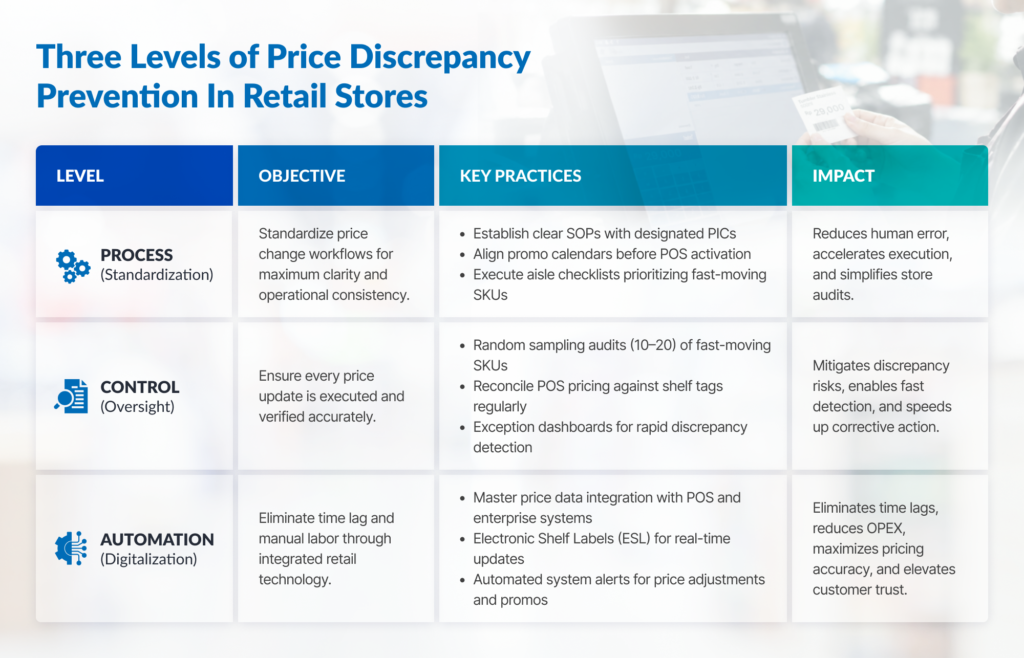
How to Prevent Price Discrepancies: Process, Control, and Automation
Addressing price discrepancies requires a structured, multi-tiered approach that scales from basic operational discipline to technology adoption.
| Level | Focus Area | Actionable Steps |
| Level 1: Process Improvement (Immediate, No Cost) | Operational Discipline | • Establish a single source of truth for pricing master data. • Schedule paper tag updates before price changes activate on POS. • Prioritize fast-moving goods and promotional SKUs during tag swaps. • Implement daily random spot checks covering 10–20 SKUs. • Set a clear cashier resolution policy to handle mismatches instantly. |
| Level 2: Control & Audit (Systematic Tracking) | Verification & Metrics | • Log every pricing error by store, SKU, time, and root cause. • Review promo calendars weekly to catch conflicting discount rules. • Conduct category-level price audits on a rotating basis. |
| Level 3: Process Automation (Structural Resolution) | Integrated Infrastructure | • Deploy centralized price management systems that push updates to all shelf display points simultaneously, eliminating time lags. • Integrate shelf display systems directly with central POS data layers. |
While automated shelf display solutions structurally eliminate time lags and manual relabeling errors, technology alone cannot fix underlying master data inconsistencies or poor promotional planning. Operational discipline remains essential at every scale.
Frequently Asked Questions
If the shelf price differs from the register price, which price should apply?
Industry best practice and consumer protection standards dictate honoring the lower price displayed on the shelf. Doing so preserves customer trust, prevents checkout friction, and ensures compliance with transparent pricing disclosure rules. Retailers should establish clear, storewide Standard Operating Procedures (SOPs) to handle these discrepancies consistently.
Is a retail store legally required to give the lower price to the customer?
Under Indonesian Consumer Protection Law (UU No. 8/1999), consumers are legally entitled to accurate, truthful, and non-misleading pricing information. Furthermore, under modern retail regulations issued by the Ministry of Trade (Permendag No. 35/M-DAG/PER/7/2013), if a discrepancy occurs between the shelf tag and the POS scan, retailers are required to honor the lower displayed price. Charging a higher rate creates immediate legal and regulatory compliance risks.
How often should retail price audits be conducted?
Stores relying on manual paper labeling should execute daily random spot checks across 10 to 20 high-velocity SKUs, paired with comprehensive weekly category-level audits.
Which cause of price discrepancy occurs most frequently across retail networks?
The most prevalent cause is the operational time lag between central POS system updates and physical shelf tag replacement on the sales floor, particularly during fast-paced promotional transitions.
Can digital shelf labels completely eliminate price discrepancies?
Electronic Shelf Labels (ESL) structurally eliminate display timing lags, manual tag placement errors, and physical degradation. However, because ESL displays pull directly from central repositories, discrepancies caused by backend master data sync failures or overlapping promotion rules still require strict database hygiene.
How should cashiers be trained to handle price mismatch complaints?
Cashiers should be empowered to override minor price variances immediately at the register without requiring protracted supervisor approval. To ensure long-term resolution, every price adjustment must be logged into the store system to facilitate root-cause analysis by the operations team.
Building a Foundation for Price Accuracy
Price discrepancies between shelf tags and registers aren’t caused by careless staff, but stem from the structural flaws built into manual paper workflows. While spot checks and manual audits offer temporary relief, achieving true long-term pricing accuracy requires connecting physical shelf-edge displays directly with central enterprise databases.
For more practical strategies on maintaining shelf-edge pricing accuracy and improving store workflows, browse our full collection of retail operational guides here.