Digital scales are a common fixture in the retail industry, ranging from fruit stands to fresh produce sections in supermarkets. However, relying on traditional, non-integrated scales often introduces various operational bottlenecks: long checkout queues, product code input errors, and unreadable barcodes at the cash register.
On the other hand, modern consumer behavior demands speed, precision, and service flexibility. These operational hurdles are not only inefficient but can also erode customer satisfaction and potentially damage your brand reputation in the long run.
This article explores modern retail digital scale solutions, covering:
- An overview of digital scales and their core components
- Five primary functions of digital scales for retail businesses
- The different types of digital scales
- Key operational benefits for your store
Read on to discover the right solution for your business; whether your goal is to optimize operational efficiency or elevate the customer experience.
Understanding Digital Scale Technology for Modern Retail
A retail digital scale is a modern weighing device designed to precisely measure product weight while automatically calculating the total selling price. Unlike conventional models, these tools come with built-in automation features to accelerate service, improve accuracy, and minimize the risk of financial loss caused by manual recording errors at checkout.
Unlike mechanical scales, which rely on indicator needles that are highly susceptible to human error, or home kitchen scales that only measure mass without pricing calculations, retail scales are purpose-built to adapt to the operational workflows and business models of various storefronts.
Technically, these scales operate via three core components:
- Load Cell: Accurately measures and detects the weight pressure of items.
- Digital Processing Unit: Calculates the total price based on weight and unit price per product.
- Indicator Display: Transparently presents product weight and total cost information to both buyers and staff.
More advanced models also feature an integrated thermal printer to print ready-to-scan price labels or barcodes, alongside network connectivity for seamless data integration with Point-of-Sale (POS) systems.
Five Core Functions of Digital Scales
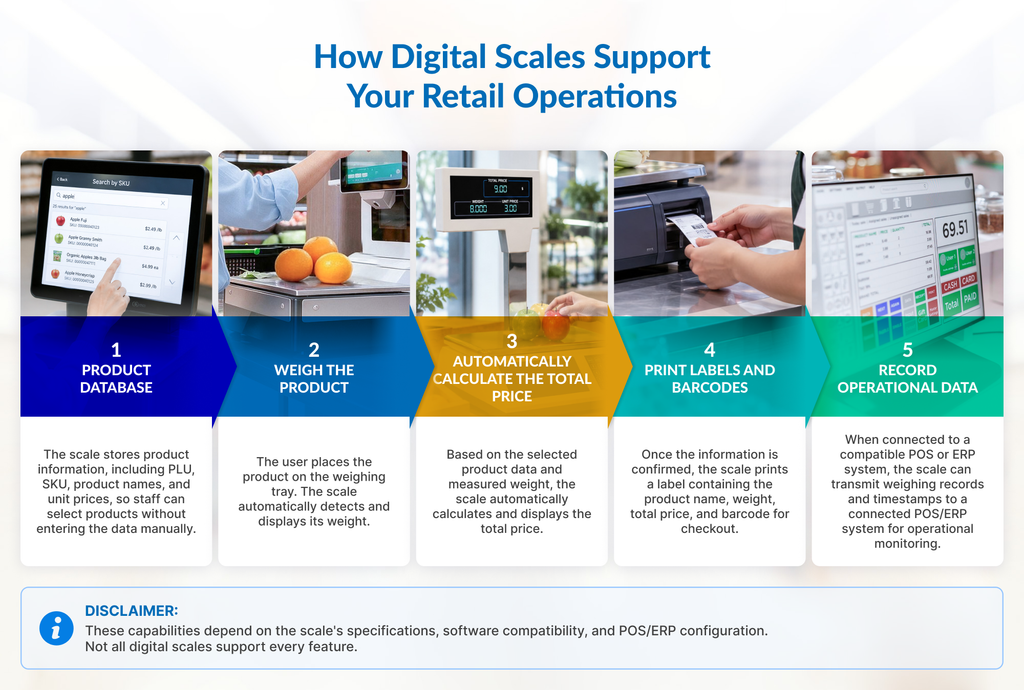
Combining the fundamental principles of measuring instruments with the fast-paced demands of retail, modern digital scales deliver five key functions to support your store’s operational efficiency:
1. Accurate Weight Measurement
Customer trust is the foundation of retail survival. Digital scales provide complete transparency, ensuring that the quantity of goods a customer receives always matches the price paid.
Operational Benefit: Eliminates profit loss caused by weight discrepancies (shrinkage) while preventing customer complaints regarding inaccurate measurements.
2. Automatic Price Calculator
Evolving beyond a simple measuring tool, digital scales automatically calculate total prices by multiplying the product’s actual weight by its unit price within seconds.
Operational Benefit: Streamlines transactions to be much faster and more accurate, as staff no longer need to manually calculate totals.
3. Label and Barcode Printing
Beyond measuring and calculating, label-printing digital scales can print thermal labels containing barcodes with embedded product data, weight, and total price.
Operational Benefit: Checkout staff simply scan the barcode at the payment counter without manually inputting data or prices, significantly reducing checkout queues.
4. Product Data Storage (PLU/SKU)
Digital scales function as local databases to store product information, such as Price Look-Up (PLU) codes, Stock Keeping Units (SKUs), item names, and unit prices per kilogram. This data can be managed manually on the device or updated centrally via supporting software.
Operational Benefit: Staff no longer need to memorize item codes or reference easily misplaced, outdated paper price lists.
5. Operational Data Source
When connected to a network, digital scales transmit timestamps and weighing history to central systems (POS/ERP) with every transaction.
Operational Benefit: Management gains real-time data on store peak hours, fresh product sales trends, and weighing volumes to drive strategic decision-making.
Types of Retail Digital Scales
To accommodate diverse business scales, operational models, and product variations, digital scales are available in several primary types:
1. Price Computing Scale
Price computing scales offer the practicality of automated price calculation as items are weighed. Delivered without printers or complex features, this type is an ideal option for small-scale stores with limited product varieties, such as independent fruit stands.
2. Label Printing Scale
Equipped with label and barcode printing capabilities, this scale displays product names, weights, and total prices. It is most commonly found in supermarket fresh produce sections. Utilizing thermal printing mechanisms, you save operational costs by eliminating the need for ink or ribbons. The resulting barcodes print precisely and remain clear when scanned at checkout, sparing staff from manual data entry.
3. POS-Integrated Scale
True to its name, this scale synchronizes directly with the same database used by your Point-of-Sale (POS) system. This removes the need to manually update price data on individual scale units whenever product prices change.
4. Self-Service Scale
Self-service scales empower shoppers to weigh their own items independently, creating a fast and personalized shopping journey. These solutions typically feature touchscreen interfaces with clear product visuals. Operationally, self-service scales effectively reduce fruit and vegetable queue congestion while serving as an ideal solution for stores facing staff shortages.
5. Checkout Scale
Installed directly at the cash register, this scale optimizes the final transaction workflow. For maximum functionality, checkout scales are typically paired with a barcode scanner. In short, cashiers can weigh, scan barcodes, and confirm product details into the purchase list from a single point. Staff no longer need to walk back and forth to the fresh produce area to verify prices, drastically shortening customer checkout times and clearing payment queues simultaneously.
6. Network-Connected Smart Scale
For multi-outlet businesses with branches spread across different locations, managing scale units separately consumes significant time and labor costs. Network-enabled smart scales solve this challenge.
Eliminating separate device configurations, managers simply access a central system to handle product information (PLU/SKU numbers, price updates, device status monitoring, and daily reporting), instantly updating all scale units across every branch automatically.
Comparison Table: Digital Scale Types in Modern Retail
| Scale Type | Best Suited For | Key Advantages | System Integration |
| Price Computing Scale | Convenience stores, independent fruit shops, & small kiosks | Calculates total prices automatically without printing labels | None (Stand-alone) |
| Label Printing Scale | Supermarkets & fresh food sections | Prints thermal labels & scan-ready barcodes for checkout | Basic (PLU data import/export) |
| POS-Integrated Scale | Stores/minimarkets with digital cash register systems | Automated price synchronization between scale and POS | Medium (Connected to POS system) |
| Self-Service Scale | High-traffic vegetable, fruit, & bulk goods areas | Independent weighing, queue reduction, & optimized staff allocation | Medium (Connected to POS/Database) |
| Checkout Scale | Checkout counters (integrated cashiers) | Weighs and scans barcodes simultaneously at a single point | High (Combined with checkout hardware) |
| Network-Connected Smart Scale | Multi-outlet retail chains & large store networks | Centralized price management, SKU data, and reporting from HQ | High (Fully integrated with Cloud/ERP) |
Business Benefits of Retail Digital Scales
Implementing retail digital scales goes beyond modernizing equipment—it is a strategic investment that directly impacts store efficiency and profitability. These core benefits span four key pillars:
1. Operational Efficiency and Speed
Service Speed
Automated weighing and instant barcode scanning cut transaction durations, significantly reducing wait times in fresh food and checkout areas.
Staff Work Efficiency
Automated price calculation and centralized PLU data storage eliminate manual math and paper-based code searches, lightening staff workloads so they can focus on customer service.
2. Accuracy and Business Compliance
Price & Weight Accuracy
Precision sensor technology ensures pricing always matches the true weight of goods, minimizing cash discrepancies, customer complaints, and potential regulatory metrology penalties.
Shrinkage Control
Digital tracking of weighing history helps management monitor and identify variances between incoming fresh product stock volumes and successful checkout transactions.
3. Multi-Outlet Standardization and Governance
Cross-Outlet Consistency
Network-enabled data integration ensures all branches utilize uniform product naming, PLU codes, and pricing structures without requiring manual updates at individual stores.
Data-Driven Decision Making
Timestamps and daily weighing volumes deliver real-time analytics regarding fresh product sales trends, peak operational hours, and projected future scale procurement needs.
4. Customer Experience and Trust
Seamless Shopping Experience
Clear thermal label prints transparently display weight and pricing details, offering shoppers peace of mind while fostering a friction-free shopping journey.
Store Types That Need Digital Scales Most
While foundational principles remain consistent, functional requirements for digital scales vary based on operational models and sold commodities. Recommended scale types tailored to specific business sectors include:
- Supermarkets & Hypermarkets: Label-printing and POS-integrated scales to manage high-volume fresh food transactions, ensure sharp barcode printing, and accelerate checkout queues.
- Fruit and Vegetable Stores: Responsive price computing or self-service scales to accelerate staff-assisted or self-weighing processes amidst high daily frequencies of unpackaged bulk goods.
- Modern Fresh Markets: Network-linked smart scales to centrally standardize pricing and product data across multiple stalls or fresh produce booths without manual adjustments.
- Bulk Goods Stores (Grains, Nuts, Spices): High-accuracy digital scales with sensitive capacities to measure small gram increments precisely, preventing shrinkage on high-value-per-gram items.
- Meat & Seafood Shops: Devices resistant to high humidity and wet environments, equipped with rapid label printing to ensure net weights are displayed accurately without compromising hygiene.
- Pharmacies (Compounding Areas): High-precision digital scales (milligram to gram scale) to guarantee accurate dosages of active ingredients in prescription medications for patient safety.
- Hardware & Building Supply Stores (Nails, Cables, Bulk Paint): Sturdy, heavy-capacity digital scales to weigh bulk materials like nails, bolts, cable spools, or paint quantities without damaging device sensors.
- Caterers & Culinary Centers: Portable, practical scales to maintain consistency in mass food ingredient portions, safeguarding standardized sizing and production cost controls.
Factors to Consider Before Choosing a Digital Scale
Selecting a digital scale for retail operations requires looking beyond price tags or aesthetics. Choosing the wrong specifications can hinder store operations or trigger long-term financial losses. Review these six crucial factors before making a purchasing decision:
1. Capacity and Precision Levels
Align maximum capacity and accuracy levels with the types of products you sell. Stores selling small-gram specialty spices require vastly different sensitivity levels compared to fruit shops or wholesale grocery outlets handling dozens of kilograms.
2. Environmental Durability
Evaluate the physical conditions of where the scale will be placed. For wet areas like meat, seafood, or fresh produce counters, ensure devices carry water-resistant certifications. Meanwhile, dusty warehouses or hardware stores demand units with rugged protective casings.
3. Legal Metrology Compliance (Tera & Tera Ulang)
Verify that the scale you purchase complies with local legal frameworks (such as official calibration and re-verification licenses from relevant Legal Metrology authorities). Meeting these requirements protects your business from legal penalties while maintaining consumer trust in measurement validity.
4. POS/ERP Compatibility and Integration Readiness
If your store utilizes a digital cash register system or inventory management software, ensure the chosen scale integrates smoothly with your existing technology ecosystem. Synchronization capabilities save staff from exhausting, time-consuming manual price data entry.
5. Availability of After-Sales Service and Spare Parts
Choose brands that offer transparent servicing options, replacement component availability (spare parts), and supporting supplies like thermal paper rolls. Reliable after-sales support ensures devices can be repaired immediately during technical issues.
6. Learning Curve and Staff Usability
The more intuitive the device interface, the faster store employees can operate it without triggering input errors. Select scales with clearly marked function keys or responsive touchscreens to ensure smooth staff adaptation without delaying queues.
Frequently Asked Questions (FAQ)
1. What is the difference between a retail digital scale and a regular scale?
Retail scales are specifically designed for commercial needs featuring automated price calculations, dual displays for customers and cashiers, and optional barcode printing. Unlike standard kitchen or mechanical scales that only measure mass manually, retail scales integrate directly with store operations to accelerate transactions and minimize input errors.
2. Are digital scales legally required to be periodically calibrated (tera)?
Yes, mandatory compliance applies. Under Law No. 2 of 1981 concerning Legal Metrology, all measuring, measuring-out, and weighing instruments used in commercial transactions must be legally verified and undergo periodic re-verification. This ensures measurement accuracy, maintains legal compliance, and protects consumers from losses caused by weight discrepancies.
3. Can digital scales connect to a Point-of-Sale (POS) system?
Absolutely. Most modern digital scales (particularly POS-integrated and smart scales) include network connectivity features. These devices synchronize directly with store POS systems or inventory software, connecting price and transaction data in real-time without manual input.
4. What is the typical lifespan of a retail digital scale?
High-quality retail digital scales generally last between 5 to 10 years, heavily depending on usage intensity, load capacity, and routine maintenance. Keeping load cell sensors clean, avoiding heavy impacts, and performing regular calibrations or re-verifications significantly extends device longevity.
5. Are digital scales durable enough for wet areas or chillers?
Not all digital scales withstand wet environments. For fresh food, meat, or seafood sections, specialized water-resistant scales with high IP ratings are required. These devices feature protected bodies and internal components built to endure water splashes, high humidity, and cold temperatures.
6. What is a self-service scale, and is it suitable for my store?
Self-service scales feature intuitive touchscreens and product images, allowing shoppers to weigh items independently. They are ideal for large supermarkets or high-traffic fruit shops, proving effective at clearing long queues in fresh produce sections while optimizing staff allocations.
7. How can I update prices across multiple scales simultaneously?
Bulk price updates across numerous scale units are accomplished using smart scales connected to centralized systems (cloud or local servers). Through an office computer, managers update price data or PLU/SKU numbers once, and the system automatically updates all scale units across all branches.
Build the Right Foundation for More Efficient Retail Operations
Ready to take the next step in determining the most precise weighing technology for your store?
Explore our other articles covering digital scale technologies to dive deeper into technical specifications, budget calculations, and integration strategies for your business POS systems.